Extended Description of the Vector Map
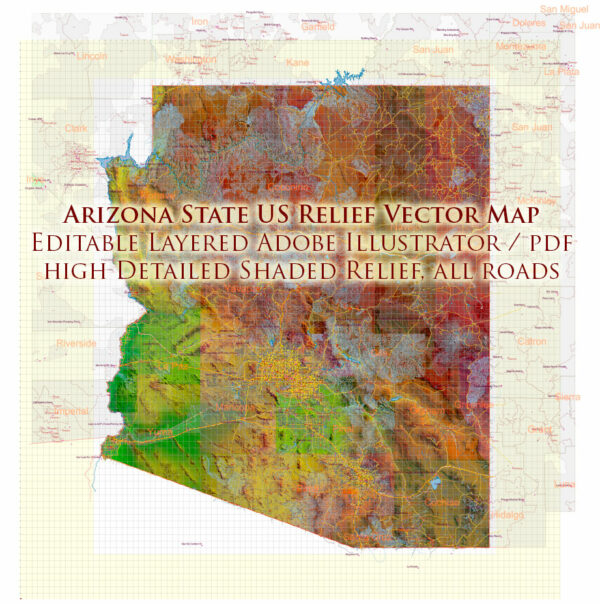
Printable Shaded Relief PDF Vector Map of Arizona State, US High Detailed Plan full editable Adobe PDF Road Admin Map in layers, scalable, text format all names, 1.431 MB ZIP
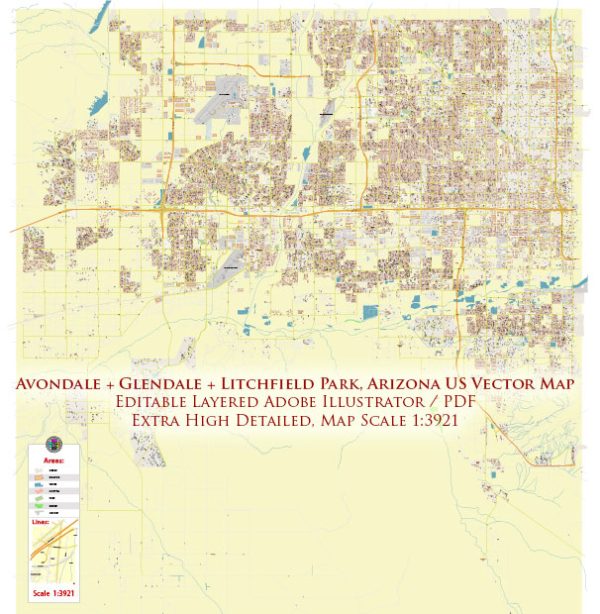
All streets and roads, Principal street names, All Cities and Towns, Zipcodes, Airports and Heliports, Main Objects, Counties, raster Shaded Relief HD. Map for design, printing, arts, projects, presentations, for architects, designers, and builders, business, logistics.
The most exact and detailed map of the state in scale.
For Editing and High-Quality Printing, Royalty free

Arizona State US PDF Map Vector Exact Shaded Reliaf and Roads High Detailed Map + Counties + Zipcodes editable Adobe PDF in layers
Layers list:
- Legend
- Grids
- Labels of roads
- Names of places (city, hamlet, etc.)
- Points of the Cities and Towns 2
- Airports and Heliports names
- Points of the Airports and Heliports
- Names of objects (hospitals, schools, parks, water)
- Names of main streets
- Names of Counties
- Principal Streets and Roads
- Residential streets
- Railroads
- ZIP Codes numbers
- ZIP Codes areas
- Airports and Heliports areas
- Water objects (rivers, lakes, ponds)
- Waterways
- Color fills (parks, hospital areas, school areas, land use, etc.)
- Islands
- Counties areas
- Shader Relief Raster JPG HD
- Background
AO Brief — State of Arizona (USA)
1) AO Snapshot
-
Area of Operations (AO): Arizona, U.S. Southwest; landlocked.
-
Borders: California (W), Nevada (NW), Utah (N), New Mexico (E), Mexico/Sonora (S).
-
Capital / main hub: Phoenix (central-south).
-
Population: ~7–8 million; highly concentrated in the Phoenix metro and Tucson corridor.
-
Strategic character: A “corridor state”—movement funnels along a few major highways and valleys; large low-density deserts and rugged highlands dominate the rest.
2) Key Terrain & Relief (What the ground “does”)
Arizona is a state of big elevation swings and distinct terrain bands:
A) Colorado Plateau (North / Northeast)
-
High elevation (often 4,000–7,000+ ft / 1,200–2,100+ m), cooler winters.
-
Major features: Grand Canyon region, vast mesas, canyons, red-rock country.
-
Mobility: Good where highways exist, but off-road can be limited by cliffs, washes, and protected lands.
B) Central Highlands / Mogollon Rim (Across the middle)
C) Basin and Range Desert (South / Southwest)
-
Low desert basins broken by rugged mountain ranges.
-
Hottest and driest sector; major population and logistics nodes sit here (Phoenix–Tucson).
-
Mobility: Excellent on paved routes; off-road is variable (soft sand, rocky washes, restricted areas).
D) Highest Ground
-
San Francisco Peaks near Flagstaff (Arizona’s highest terrain).
-
High ground influences weather, line-of-sight, and winter travel constraints.
3) Climate & Environmental Conditions (Operational effects)
-
Heat: Summer low deserts often exceed 40°C / 104°F; heat injuries and equipment overheating are primary risks.
-
Monsoon season (summer): Short, intense storms → flash floods, mud, reduced visibility; dry washes can become torrents quickly.
-
Winter: Snow/ice likely in higher elevations (Flagstaff, Rim country); passes can become bottlenecks.
-
Dust: Windblown dust reduces visibility; impacts aviation and ground movement.
-
Water scarcity: Critical constraint outside cities—treat water as a strategic resource.
4) Hydrography (Waterways / crossing points)
-
Colorado River forms much of the western boundary—major barrier with limited crossings.
-
Gila River and Salt River shape southern/central basins (many sections are controlled channels/reservoir systems).
-
Key reservoirs/lakes (orientation-level): Lake Powell area (north), Lake Mead approaches (northwest), and central/southern reservoirs near metro areas.
-
Flash-flood network: Arroyos and washes are common; crossings can be deceptively risky.
5) Major Roads & Mobility Corridors (Primary “lanes”)
Arizona’s movement is dominated by a few interstate spines:
Primary Interstates
-
I-10 (West–East): California → Phoenix → Tucson → New Mexico
-
I-17 (South–North): Phoenix ↔ Flagstaff
-
I-40 (West–East, North): California → Kingman/Flagstaff corridor → New Mexico
-
I-8 (Far South/West): Connects toward San Diego via Yuma
Important U.S. Routes (secondary but operationally significant)
-
US-93: Phoenix area ↔ Kingman; major route toward Las Vegas.
-
US-60: Phoenix ↔ eastern/central communities; links mining and mountain towns.
-
US-89 / US-89A: Flagstaff ↔ northern scenic corridor; access to canyon country.
-
US-191 (east): Runs through sparse highlands; long distances between services.
Choke Points & Constraints (typical)
-
Mountain passes on I-17 and Rim approaches.
-
River crossings (especially near the Colorado River) are limited to a few bridges/dams.
-
Urban bottlenecks: Phoenix freeway loops and the Phoenix–Tucson segment of I-10 during peak hours.
6) Air & Rail (Access and lift nodes)
Airports (high-level)
-
Phoenix area: Major international airport + multiple reliever airports (dense aviation ecosystem).
-
Tucson: Significant regional airport and aviation industry presence.
-
Flagstaff/Yuma: Smaller but strategically located for north/high-country and southwest/border regions.
Rail
7) Cities & Population Centers (Human terrain)
Primary Metro Areas
Secondary Cities / Regional Nodes
-
Mesa, Chandler, Gilbert, Scottsdale, Tempe: Phoenix-area sub-centers (often function like separate cities).
-
Flagstaff (North-Central): High-country node on I-40; gateway to plateau/canyon regions.
-
Yuma (Southwest): Border-adjacent; desert crossing hub; agriculture and military presence nearby.
-
Prescott / Prescott Valley: Central highlands; regional services.
-
Kingman (Northwest): Key junction area near I-40/US-93.
-
Lake Havasu City (West-Central): Colorado River recreation corridor.
-
Sierra Vista (Southeast): Border-region community with defense/military significance.
Settlement Pattern
-
Highly clustered in the Phoenix–Tucson “Sun Corridor.”
-
Vast tracts of very low density elsewhere, including large areas of tribal lands, federal land, and protected parks/forests.
8) Demographics & Civil Considerations (Orientation-level)
-
Languages: English dominant; Spanish widely spoken in many communities.
-
Tribal Nations: Arizona has a large Native/Indigenous presence and multiple sovereign tribal nations with distinct jurisdictions (permits, access rules, law enforcement coordination).
-
Cross-border dynamics: Significant legal trade/traffic and cultural ties with Mexico; border infrastructure and enforcement can affect movement patterns.
-
Key industries: Services/tech (Phoenix), higher education and aerospace/defense-adjacent sectors (Phoenix/Tucson), tourism (statewide), mining (select regions), agriculture (river valleys, especially southwest).
9) Natural & Cultural Points of Interest (Landmarks / attractions)
Major Natural Icons
-
Grand Canyon (north): massive canyon terrain; restricted access and limited crossing points.
-
Sedona Red Rocks (north-central): rugged scenic country; tourism-dense.
-
Monument Valley / Navajo Nation lands (northeast): iconic mesas; access governed by local/tribal rules.
-
Petrified Forest (east/northeast): desert badlands and fossilized wood deposits.
-
Saguaro National Park (near Tucson): classic Sonoran Desert saguaro landscapes.
-
Canyon de Chelly (northeast): deep canyon system on tribal land.
-
Havasu / Colorado River corridor (west): river access, cliffs, and recreation zones.
Environmental hazards in attraction zones
-
Heat exposure, dehydration, flash floods, and limited cell coverage—especially away from main highways.
10) Ground Mobility Notes (Practical)
-
Fuel & services: Reliable on interstates; sparse on many rural routes—plan range and redundancy.
-
Off-road: Highly variable—soft sand, sharp rock, and “washes” can trap vehicles; many areas are protected or require permits.
-
Night movement: Clear skies help, but wildlife and unlit roads raise collision risk.
11) “AO Summary” (One-glance takeaways)
-
Arizona is shaped by two main long-haul corridors: I-10 (south) and I-40 (north), tied together by I-17 through rugged high country.
-
Population and infrastructure cluster in the Phoenix–Tucson belt; the rest is sparse, rugged, and often jurisdictionally complex (federal/tribal/protected lands).
-
Weather is an operational factor: extreme heat, monsoon flash floods, and winter snow at elevation create real constraints.

Arizona State US PDF Map Vector Exact Shaded Reliaf and Roads High Detailed Map + Counties + Zipcodes editable Adobe PDF in layers

Arizona State US PDF Map Vector Exact Shaded Reliaf and Roads High Detailed Map + Counties + Zipcodes editable Adobe PDF in layers

Arizona State US PDF Map Vector Exact Shaded Reliaf and Roads High Detailed Map + Counties + Zipcodes editable Adobe PDF in layers

Arizona State US PDF Map Vector Exact Shaded Reliaf and Roads High Detailed Map + Counties + Zipcodes editable Adobe PDF in layers

Arizona State US PDF Map Vector Exact Shaded Reliaf and Roads High Detailed Map + Counties + Zipcodes editable Adobe PDF in layers

Arizona State US PDF Map Vector Exact Shaded Reliaf and Roads High Detailed Map + Counties + Zipcodes editable Adobe PDF in layers

Arizona State US PDF Map Vector Exact Shaded Reliaf and Roads High Detailed Map + Counties + Zipcodes editable Adobe PDF in layers

Arizona State US PDF Map Vector Exact Shaded Reliaf and Roads High Detailed Map + Counties + Zipcodes editable Adobe PDF in layers

Arizona State US PDF Map Vector Exact Shaded Reliaf and Roads High Detailed Map + Counties + Zipcodes editable Adobe PDF in layers

Arizona State US PDF Map Vector Exact Shaded Reliaf and Roads High Detailed Map + Counties + Zipcodes editable Adobe PDF in layers

Arizona State US PDF Map Vector Exact Shaded Reliaf and Roads High Detailed Map + Counties + Zipcodes editable Adobe PDF in layers

Arizona State US PDF Map Vector Exact Shaded Reliaf and Roads High Detailed Map + Counties + Zipcodes editable Adobe PDF in layers

Arizona State US PDF Map Vector Exact Shaded Reliaf and Roads High Detailed Map + Counties + Zipcodes editable Adobe PDF in layers

Arizona State US PDF Map Vector Exact Shaded Reliaf and Roads High Detailed Map + Counties + Zipcodes editable Adobe PDF in layers

Arizona State US PDF Map Vector Exact Shaded Reliaf and Roads High Detailed Map + Counties + Zipcodes editable Adobe PDF in layers

Arizona State US PDF Map Vector Exact Shaded Reliaf and Roads High Detailed Map + Counties + Zipcodes editable Adobe PDF in layers



 Author: Kirill Shrayber, Ph.D. FRGS