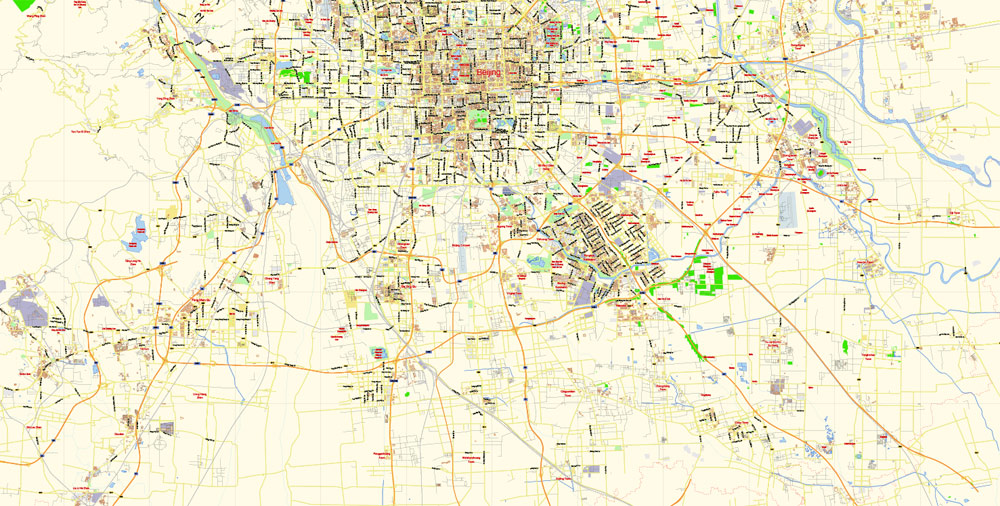
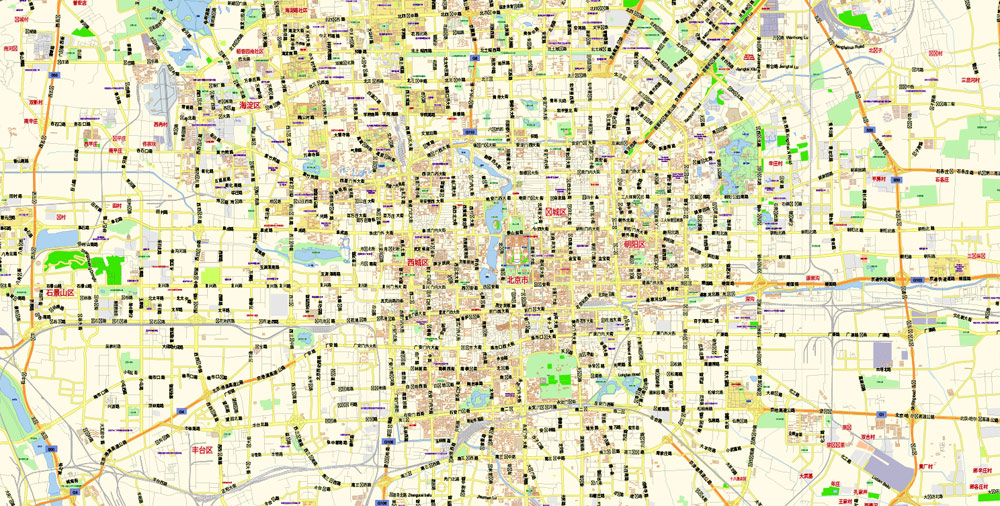
Urban plan Beijing China AI 13 Digital Cartography Vector Maps
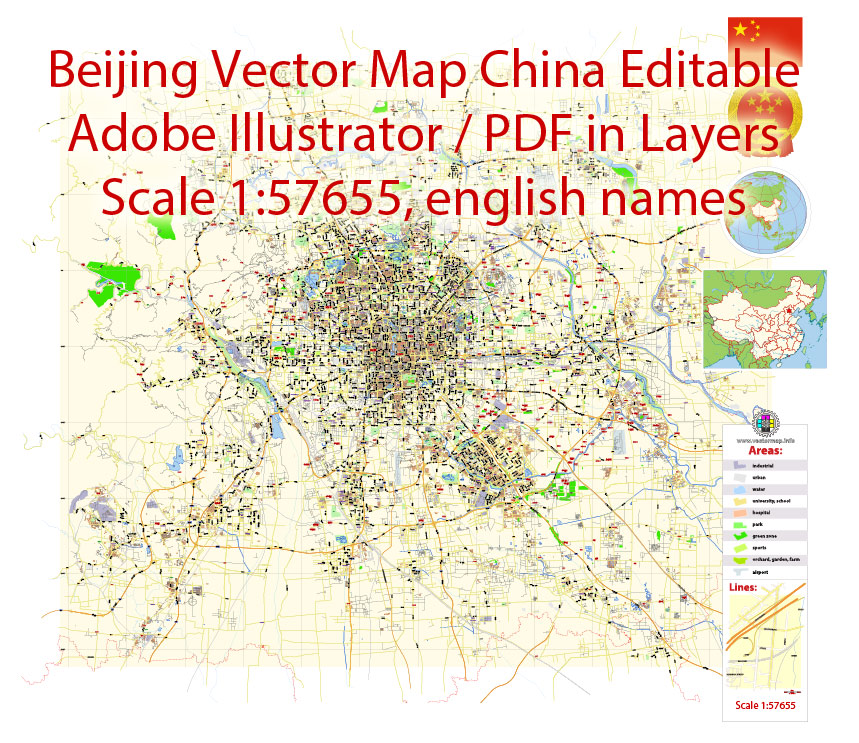
Viddeo "Urban plan Beijing China AI 13":
China Adobe Illustrator / PDF Vector Maps
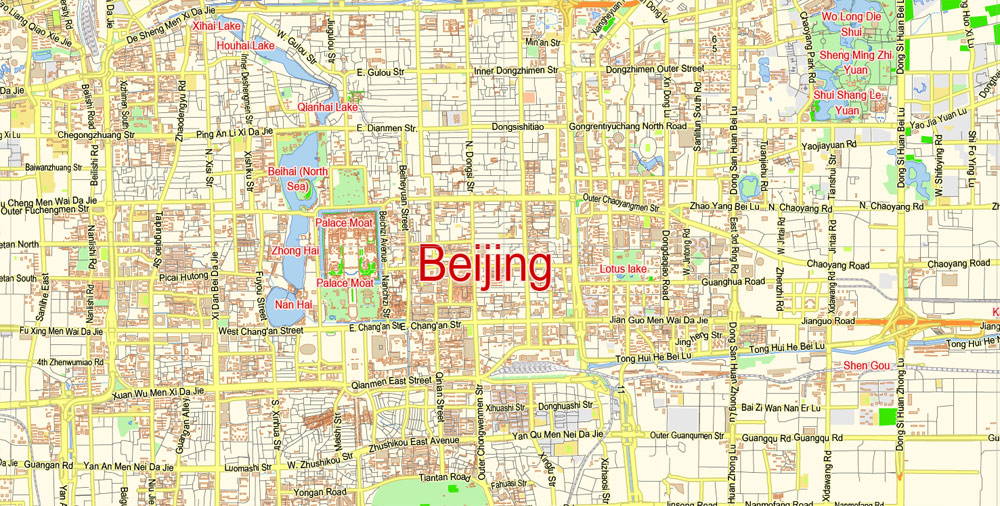
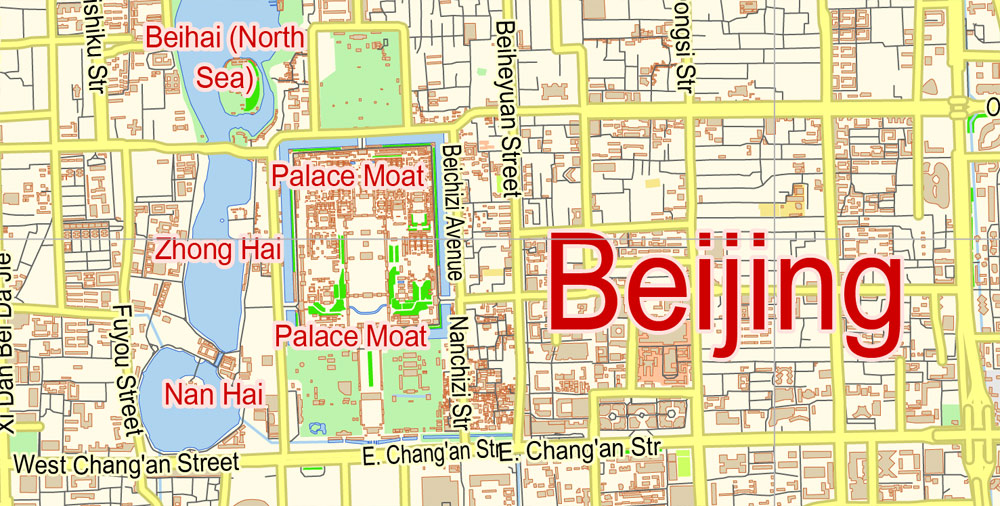
Beijing Editable Urban Plan: For printing, Logistics, Architect
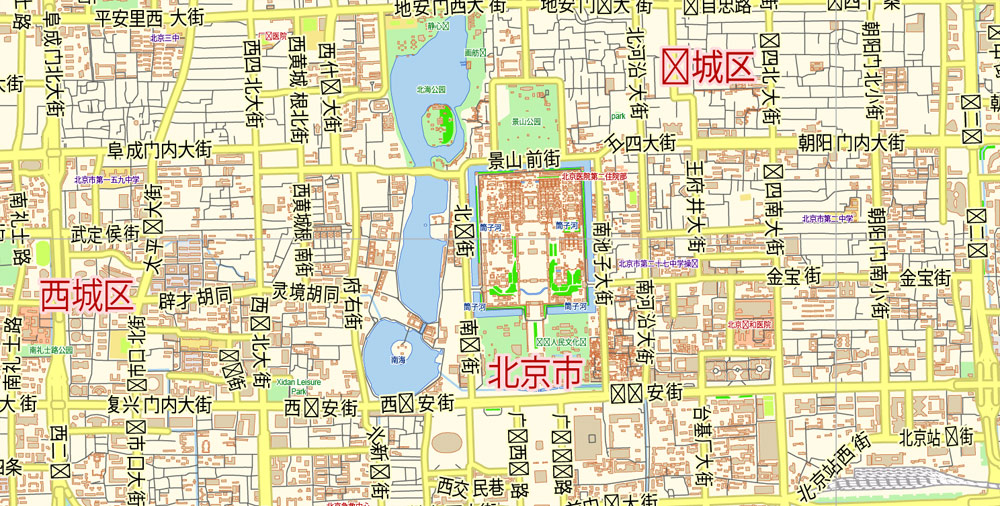
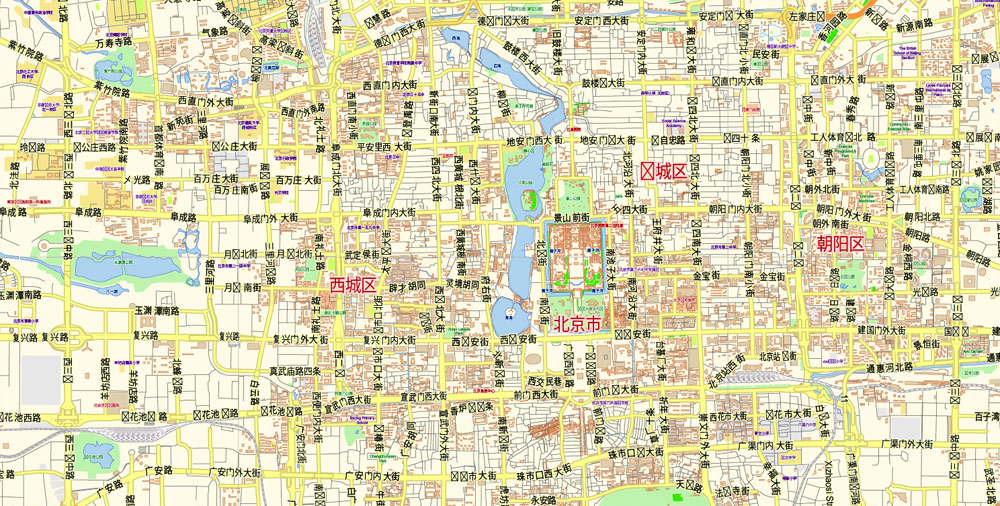
Urban plan Beijing China AI 13: City Vector Maps for Busines and Education
BRIEFLY ABOUT BEIJING
Beijing is the capital of the People's Republic of China. The area of the city is 17.8 thousand km2.
Beijing is a major industrial center of China. The development of the coal industry, automotive industry, ferrous metallurgy, light, and chemical industries negatively affects the state of the environment. Beijing is recognized as one of the most environmentally dirty cities in the world.
The city is located in the northern part of the Great Plain of China. The Xishan Mountains surround Beijing from the north and west sides. They also serve as protection against the penetration of the Mongolian steppes and deserts into the city. The highest point in Beijing is Dongling Mountain (2,023 m). The Yongding and Chaobai Rivers, which are part of the Hai-He River Basin, flow through the city.
Beijing has a humid continental climate.
Summer, influenced by the East Asian monsoon, is hot, at this time it often rains.
In winter, the city is affected by Siberian anticyclones. The air temperature at this time often falls below -10 ° C, snowfalls extremely rarely.
The average air temperature in January is -4 ... -7 ° C, in July +25 ...+26 ° C.
Beijing local time: GMT +8
MORE ABOUT BEIJING
BEIJING, the capital of the People's Republic of China, is located in northeast China, approximately 160 km northwest of the port of Tianjin. Before the formation of the People's Republic in 1949, Beijing was surrounded by a city wall and was about 8 km across. He occupied the marginal part of the agricultural territory with an area of 780 square kilometers in Hebei Province. Shortly after 1949, the city was given the status of an independent administrative unit, directly subordinate to the Central People's Government, and its territory was expanded to 17,793 square kilometers. Currently, Beijing is one of the main industrial cities of China, the cultural center, and the heart of one of the most populated metropolitan regions of the world.
GEOGRAPHICAL LOCATION AND CLIMATE.
Beijing proper is located within the lowlands at the northern tip of the North China Plain. About 3/5 of the city's territory, together with the suburbs, lies in a mountainous area, framing the old town from the west, north and east. Several rivers flow through the plain in the vicinity of Beijing, including the Baihe and Yongdinghe, which make up the main source of the city's water supply. Beijing is located within a seismically dangerous zone, and in 1976 the city of Tangshan, located 160 km east of Beijing, was destroyed by an earthquake that caused significant damage to the capital itself. The weather conditions in Beijing are affected by spring and summer monsoon winds blowing from the northwest and from the southeast. In early spring, northwest winds from the Gobi Desert envelop the city with clouds of yellow dust. In summer, south-easterly winds from the ocean cause heavy downpours, which is why about 3/4 of the annual precipitation (610 mm) falls during the summer season. In general, summer in Beijing is hot and humid, and winter is cold and dry. However, from mid-September to November, the weather is clear, cool and very pleasant.
POPULATION
Beijing grew enormously after 1949, when it had just over 2 million inhabitants, 4/5 of whom lived in the city itself. By 1988, the population of Greater Beijing was estimated to be 10,670,000 people, including almost 6,710,000 people living in the city itself. The most important reason for this growth was rapid industrialization.
LAYOUT AND ARCHITECTURE.
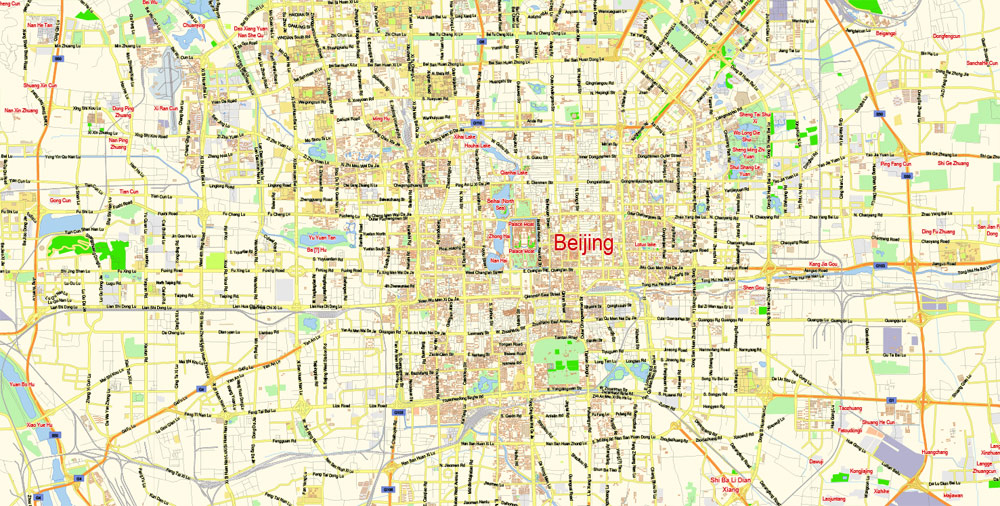
Since its founding during the Yuan Dynasty, Beijing has for the most part been the capital of China. To this day, the features associated with its dominant role in the empire are clearly visible in the appearance of the city. The territory of old Beijing is clearly divided into two parts: a square "Inner" or "Tatar City" in the north and an oblong "Outer" or "Chinese City" adjacent to it from the south.
The "Tatar City", whose name reflects its creation during the reign of the Mongol conquerors in the 13th century, was built along the main axis – a straight line crossing it from north to south, and surrounded by 12-meter walls, which were dismantled only in the 1950s. Inside the walls of the "Tatar City" with a length of about 24 km, two palace ensembles were enclosed, created mainly in the 15th century during the reign of the Ming Dynasty and also surrounded by walls.
In the very center was the Purple, or Forbidden City, framed by a moat. Behind its 3.6 km-long walls was the Imperial Palace, built from 1406 to 1420 and currently a museum. The palace complex consists of more than 9,000 rooms, its total area is about 100 hectares. The architectural ensemble includes huge gates, audience halls and living quarters. Yellow tiled roofs of buildings rise above the red adobe walls of the city. In the center of the "Forbidden City," there is the "Pavilion of Supreme Harmony", where the imperial throne was located, the "Pavilion of Complete Harmony", where political decisions were developed, and the "Pavilion of Harmony Preservation", where receptions of diplomats and academic advisers took place. Pavilions are placed on terraced pedestals, long flights of white marble stairs lead to their entrances. Each of the pavilions was arranged so that the emperor always sat with his face turned exactly to the south and having the North Star behind him. The same orientation of buildings in the direction from north to south was maintained throughout the "Tatar City", built symmetrically relative to a single meridional axis.
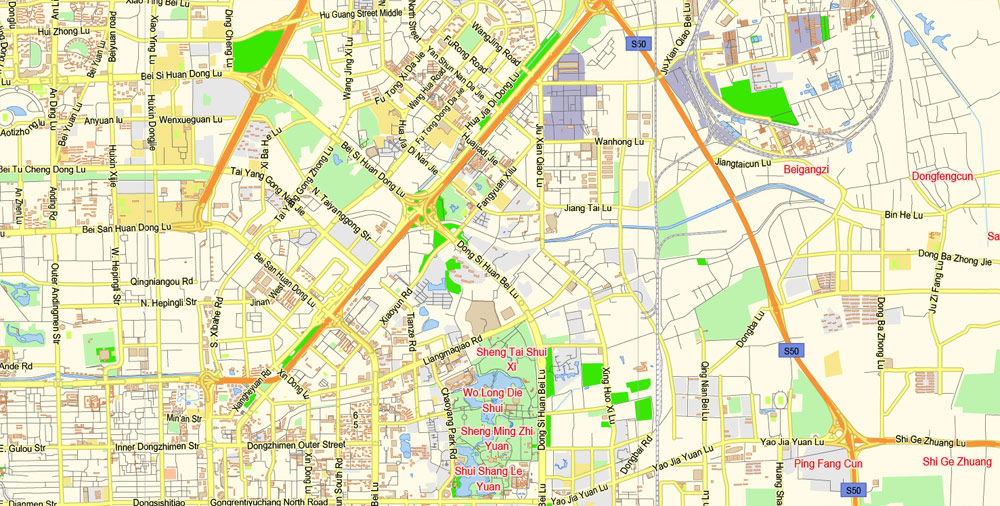
In general, the buildings of the "Forbidden City" are subordinated to a single plan. As a rule, they are one-story, with light wooden walls, and their massive roofs with elegantly raised cornices are supported by complex systems of beams and brackets supported by strong wooden columns. Buildings of this type have an important advantage: they are practically not damaged by earthquakes. However, they are extremely vulnerable to fires, and many of the surviving buildings have repeatedly required serious repairs or rebuilding over the long history of their existence. This work is carefully continued by the current Government of China.
The "Forbidden City" was surrounded by a second square of red walls with a total length of 9.7 km, inside which was located the so-called "Imperial City", which included imperial parks, temples and secondary palaces. Its southern wall has been preserved to this day, as well as sections of the western wall adjacent to two artificial lakes: Zhonghai (Central Sea) and Nanhai (South Sea). Secondary palaces were located around them, which currently serve as reception rooms and residences of the Chinese leadership. To the north is the third man-made lake, Beihai (North Sea), which is surrounded by a public park. On the island in the middle of this lake stands the famous Tibetan-style White Pagoda, built in the 17th century. The National Beijing Library and the All-China Handicrafts Exhibition are located nearby.
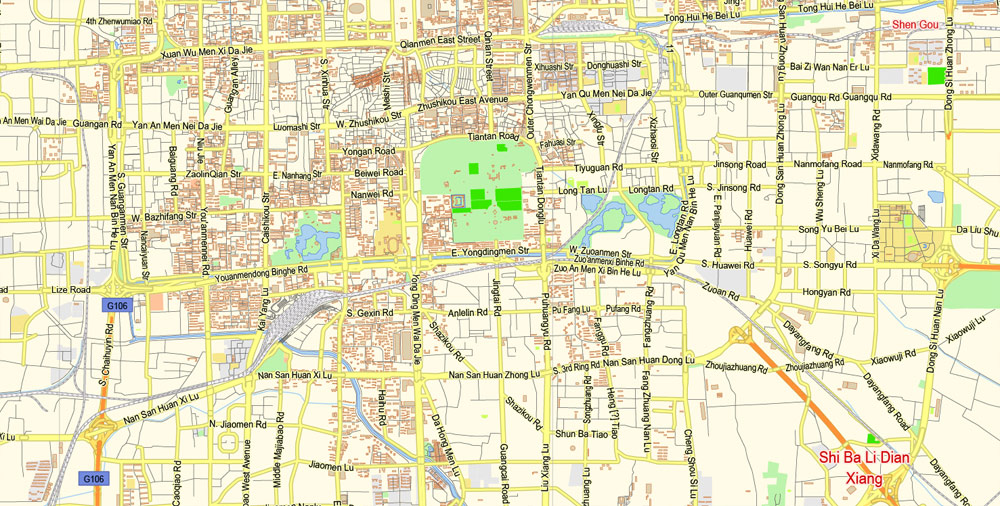
Three more parks are located inside the "Imperial City". One of them, Meishan Park, or Jingshan, is located exactly to the north of the Forbidden City on the "Coal Mountain" - an embankment hill formed during excavation during the creation of three artificial lakes of the "Imperial City". From this hill, which is the highest point of Beijing, a wide panorama of the entire capital opens. Two more parks occupy a part of the "Imperial City" located to the south of the walls of the "Forbidden City", i.e. the territory where the imperial temples used to be located. To the east of the Tiananmen Gate, on the site of the family Temple commemorating the ancestors of the emperor, there is the People's Culture Park with the Palace of Culture of Workers, and to the west of the Tiananmen Gate, inside the walls that formerly enclosed the imperial "Altar of the Deities of the Earth and Cereals", currently there is Zhongshanyuan Park, or Park named after Sun Yat-sen, the leader of the revolution of 1911-1912, which destroyed the imperial power.
South of the two named parks is the surviving southern wall of the "Imperial City", in the center of which is the famous Tiananmen Gate (Gate of Heavenly Tranquility) in the center. It was from here that Mao Zedong proclaimed the formation of the People's Republic of China in 1949, and it is here, on the huge Tiananmen Square, expanded in 1950, that the political life of the republic is concentrated. On Tiananmen Square, there is a Monument to National Heroes and the Memorial Hall of Mao Zedong - the mausoleum where the body of the Chinese leader is kept, open to the public. Along its northern border runs Changanjie (Eternal Peace Avenue), the main boulevard of Beijing. Many more modern sights of the city are located along with it. On the western side of the square, a monumental building has been erected – the House of the National People's Congress, where congresses of this supreme authority and other important state events are held. Opposite this building is an impressive complex of buildings, which houses the Historical Museum of China and the Museum of the Chinese Revolution. Grandiose demonstrations and fireworks are held on the square itself during national holidays.
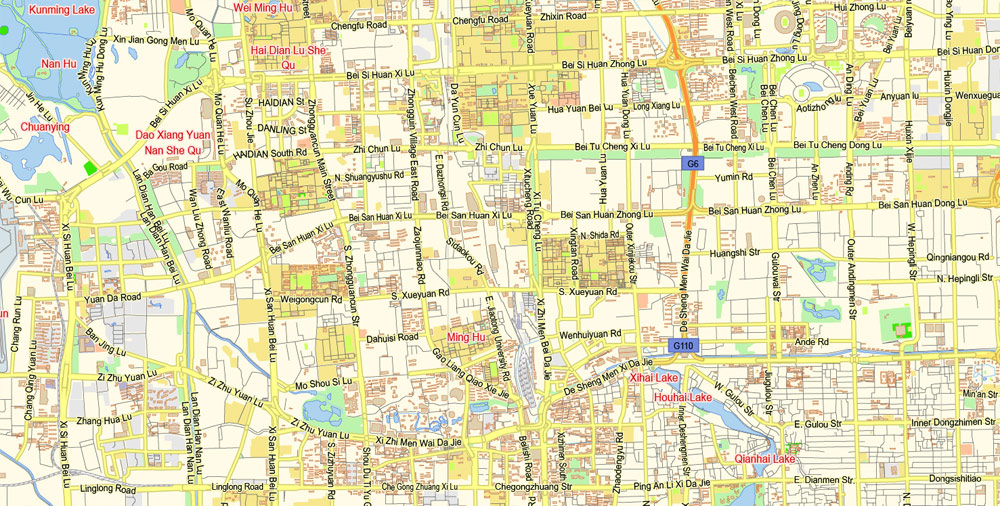
The public buildings on Tiananmen Square are probably the most important buildings of this third, outer part of the "Tatar City". Originally, the residences of the nobility, palace courtiers and imperial officials were located in this area. Later it became known as the "embassy quarter" because there were many foreign missions here. The district is intersected by many main streets stretching from east to west and from north to south, as well as a network of hutuns – secondary alleys where there are shops, restaurants, markets, and residential areas fenced with high gray walls with large red gates.
Until the 1950s, the southern wall of the "Tatar City" ran directly south of Tiananmen Square, and although later the walls and massive gates were dismantled, the line along which they passed can be traced through the preserved channels - former fortress moats filled with water. Behind these walls, the "Outer" or "Chinese City" begins, which had the shape of a rectangle in plan with dimensions of 3.2 km from north to south and 8 km from west to east. Initially, it was a territory occupied by shopping and entertainment establishments. Their owners concentrated here to serve the rich who lived inside the walls of the "Tatar city". In the middle of the 16th century, this area, in turn, was surrounded by a protective wall with a height of 6 m, and the network of its streets was ordered in accordance with the specialization of enterprises located on one or another of them: for example, for the sale of paper, writing materials, ceramic tiles, jade jewelry, cloisonne enamel, etc. This specialization has partly been preserved to this day. The "Outer City" also housed larger shopping areas, and in addition, religious temples. Most of the latter, both in the "Tatar" and "Chinese" cities, was later turned into schools and other government institutions, however, despite the fact that the "Outer City" was largely included in the mainstream of modern political life, it remains in many ways the most diverse and colorful part of Beijing.
Two large parks are located on the southern outskirts of the old "Chinese city". Tiantan (the park of the "Temple of Heaven") in the southeast contains an ensemble of buildings where important state sacrifices were once performed. One of the temple structures – the "Altar of Heaven" - is a three-stage terrace made of white marble. Three tiers symbolize three elements: heavenly, earthly, and human. The second structure, the Huangqiongyu (Hall of the Firmament), 20 m high, has an octagonal shape in plan. This building is surrounded by an artfully constructed "echo wall". The third building, the Qinyandian Hall (Harvest Prayer Hall) is a 27 m high circular building with a three-tiered roof. The dark blue glazed roof tiles, artful woodwork, and amazingly decorated interior make it one of the most attractive tourist attractions in Beijing. The whole pavilion with its decoration, rich in traditional symbols, is one of the main architectural monuments of China.
The second-largest park of the "Outer City", Taozhantin (which means "Gazebo a little drunk" in Chinese), is located to the west. Between the two named parks in the ancient imperial "Temple of Agriculture" (or "Temple of the God of Agriculture"), where the emperor himself in peasant clothes led a ritual dedicated to spring plowing and offered prayers for a generous harvest.
Other attractions of the "Outer City" include the Beijing Stadium and a complex of sports facilities located in the southeast of the city, and the huge Beijing Railway Station, located directly at the wall of the "Imperial City" on the northeastern outskirts of the "Outer City". Its construction was completed in 1959. Numerous seven- and ten-story residential buildings were also erected in the "Outer City", in addition to the four- and five-story ones built before 1949. However, in general, the silhouette of Beijing still remains relatively low, since its old one- and two-story buildings were determined by the imperial law prohibiting the construction of buildings taller than the temples of the "Forbidden City".
There is also no central business district in Beijing. Instead, large and small shopping centers are scattered throughout the city, which allows city residents to shop mostly in the same areas where they live. Probably the busiest commercial thoroughfare in Beijing is Wangfujing Street, which stretches along the eastern side of the "Imperial City" to the north of Changanjie. On this street is the 17-story Beijing Hotel, the tallest building in the old city, as well as the Beijing Department Store and Dongfeng Market– the largest indoor shopping center combining a variety of small shops and restaurants.
METROPOLITAN REGION.
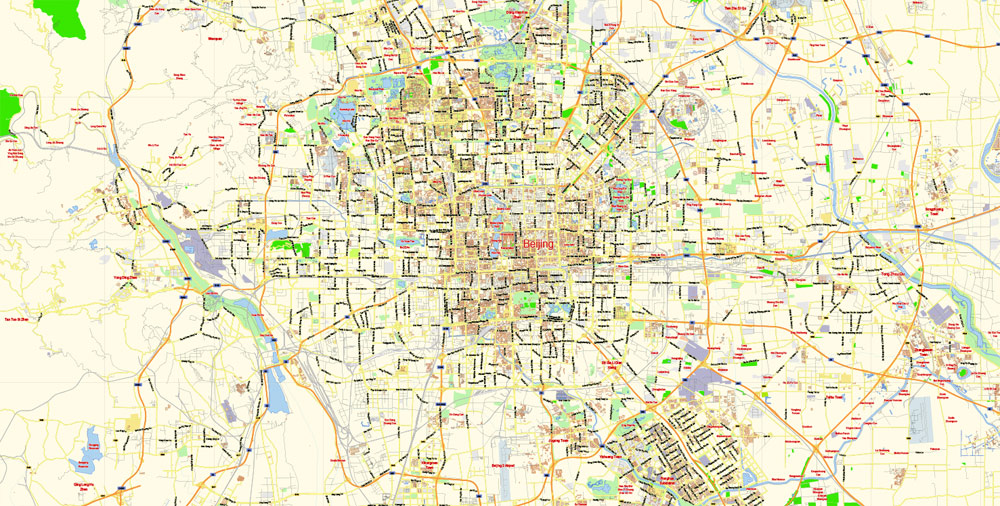
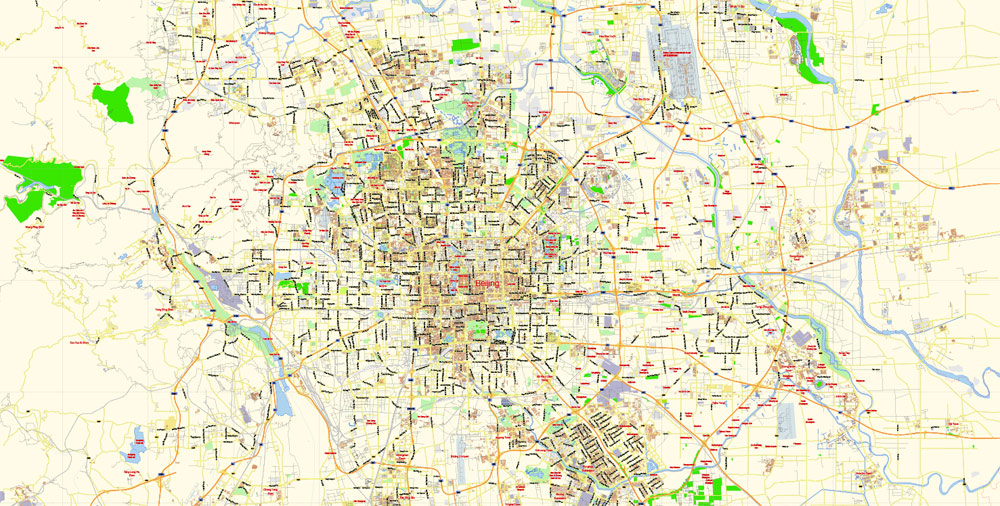
After 1949, and especially after the old city walls were demolished, Beijing expanded widely in all directions at such a rate that it is now often difficult to determine where Beijing proper ends and the suburbs begin. Moving away from the city center, the traveler sees new residential buildings, factories, and administrative buildings towering everywhere among densely planted fields. The further away from the center, the more important gardens and farms become in the landscape, however, even here there are medium and large industrial enterprises. Beijing's initial expansion plans envisioned the concentration of new industrial facilities in the southeast of the city to minimize the threat of air pollution, taking into account the prevailing wind direction, but there are numerous exceptions, and the main one among them is the large Shijingshan Metallurgical Plant, located 19 km west of the city. In other places in the west, there are numerous military camps, as well as military factories, and in the southwest, there is one of the main nuclear research centers of China. A number of large industrial complexes are located in the southern and eastern suburbs, including oil refineries, chemical and petrochemical industry enterprises, machine-building and automotive plants, as well as textile factories. Cultural and scientific institutions are mainly concentrated in the northern sector, as well as several parks, sports complexes, a zoo, and the Druzhba Hotel with a tourist center.
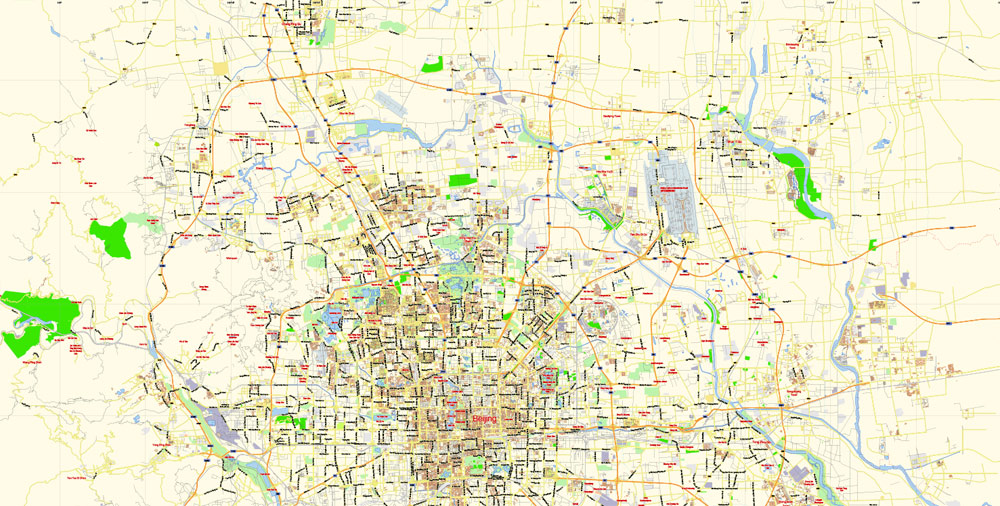
Three attractions located outside the old town deserve special attention. The first of them is the old "Summer Palace" (Yiheyuan), located 11 km northwest of the city, one of the most popular vacation spots for Beijing residents. The park has served as the location of imperial gardens and palaces since at least 1153. The modern complex consists mainly of restored buildings, the construction of which began in the late 19th century. On the territory of the park, there is Kunminhu Lake and Mount Wanshoushan (Longevity Mountain) to the north of it. Temples and elegant pagodas tower on the mountain. A long gallery runs along the shore of the lake, connecting the buildings of the palace complex at the foot of Mount Wanshoushan with each other. Beautiful bridges are thrown across the lake: the Camel's Back Bridge and the bridge with seventeen spans of Shikunqiao. In the distance, the famous "Jade Pagoda" is visible behind the bridges.
The tombs of the emperors of the Ming dynasty, located along an alley 32 km northwest of Beijing, the burial place of 13 emperors, are another attraction in the suburbs of the capital. A gently curving road ("The Path of High Virtue"), framed by monumental stone sculptures, leads to them. In front of the oval burial mounds, inside which the tombs themselves are located, rise ochre-red pavilions under traditional yellow tiled roofs with corners bent upwards.
The third outstanding attraction near Beijing is the Great Wall of China itself. The only man-made object on Earth large enough to be seen from the moon, this giant fortification passes at a distance of 48 km from Beijing. The Great Wall of China, 4,000 km long, stretches in a winding ribbon from the Yellow Sea to the Gobi Desert.
Related Images "Urban plan Beijing China AI 13":
- Urban plan Frankfurt am Main
- Urban plan Kharkiv Ukraine
- Urban plan Linggo Sari Baganti Indonesia
- Urban plan Ottawa Canada 25
- Urban plan Corrientes Resistencia PDF
- Urban plan Oakland Berkeley Richmond Alameda San Leandro Albany CDR
- Urban plan Columbia South Carolina
- Urban plan Kuwait PDF
- Urban plan Jacksonville Florida PDF
- Urban plan Austin Texas pdf
- Urban plan Portland Oregon Vancouver Washington 13
- Urban plan Colchester UK
- Urban plan Krasnoyarsk Russia
- Urban plan Jerusalem Israel 17 PDF
- Urban plan Vantaa Finland ai
- Urban plan Newport Norfolk Virginia Beach CDR
- Urban plan Barnstable Massachusetts AI
- Urban plan Tucson Arizona ai
- Urban plan Nice France PDF
- Urban plan Quebec City Canada 13 PDF
- Urban plan Shreveport Bossier
- Urban plan San Antonio
- Urban plan Columbia South Carolina PDF
- Urban plan UK Ireland PDF
- Urban plan Laval Mayenne
- Urban plan Tucson Arizona
- Urban plan Santa Cruz de Tenerife
- Urban plan Buffalo New York ai
- Urban plan Eilat Israel Aqaba Jordan
- Urban plan Java Indonesia autocad dwg
- Urban plan Montreal metro area
- Urban plan Veracruz Mexico
- Urban plan Kuala Lumpur Malaysia
- Urban plan Birmingham UK
- Urban plan Sacramento California PDF
- Urban plan Batumi Georgia
- Urban plan Kyoto Japan 13 PDF
- Urban plan Waterford Ireland
- Urban plan Leipzig Germany
- Urban plan Canada Admin Road PDF
- Urban plan Hobart Tasmania 3 10 PDF
- Urban plan Brooklyn New York PDF
- Urban plan Jerusalem Israel 17 english AI
- Urban plan Dallas
- Urban plan South Africa Admin AI
- Urban plan Melbourne Australia PDF
- Urban plan Pacific Coast US Canada PDF
- Urban plan Veracruz Mexico PDF
- Urban plan Malaga Spain PDF
- Urban plan Kuala Lumpur
- Urban plan Miami Florida 4
- Urban plan Genoa
- Urban plan Munich Munchen Germany pdf
- Urban plan Trondheim Norway
- Urban plan San Juan Puerto Rico PDF
- Urban plan Boston Massachusetts pdf
- Urban plan Bryansk pdf
- Urban plan Shanghai China 17 AI ENG
- Urban plan Milwaukee Wisconsin ai
- Urban plan Charleston South Carolina 3 10 PDF
- Urban plan Toronto Canada PDF
- Urban plan Trenton New Jersey CDR
- Urban plan Cartagena Colombia PDF
- Urban plan Vilnius Lithuania
- Urban plan Harlingen Texas 3 10 PDF
- Urban plan Kiev Ukraine
- Urban plan Toa Baja Puerto Rico PDF
- Urban plan Sacramento California pdf
- Urban plan Edmonton PDF
- Urban plan Mexico City 25
- Urban plan Islamabad Rawalpindi
- Urban plan Relief US flat
- Urban plan Norway Admin
- Urban plan Washington DC pdf
- Urban plan Minneapolis St Paul Minnesota ai
- Urban plan Austria Vector Relief Roads
- Urban plan Albury Wodonga Australia PDF 17
- Urban plan Mumbai India
- Urban plan Macau China 125 PDF
- Urban plan Stanford University PDF
- Urban plan Geelong Australia
- Urban plan Austria Admin
- Urban plan Beijing China AI 15 eng
- Urban plan Augusta Maine PDF
- Urban plan Dubai UAE CDR
- Urban plan US Relef Rivers
- Urban plan Frankfurt Germany ai
- Urban plan Vienna Wien Austria pdf
- Urban plan Boston
- Urban plan Saint Petersburg Russia
- Urban plan Sacramento California
- Urban plan Cincinnati Ohio pdf
- Urban plan Leicester pdf
- Urban plan Raleigh North Carolina