Urban plan Mumbai India: Digital Maps
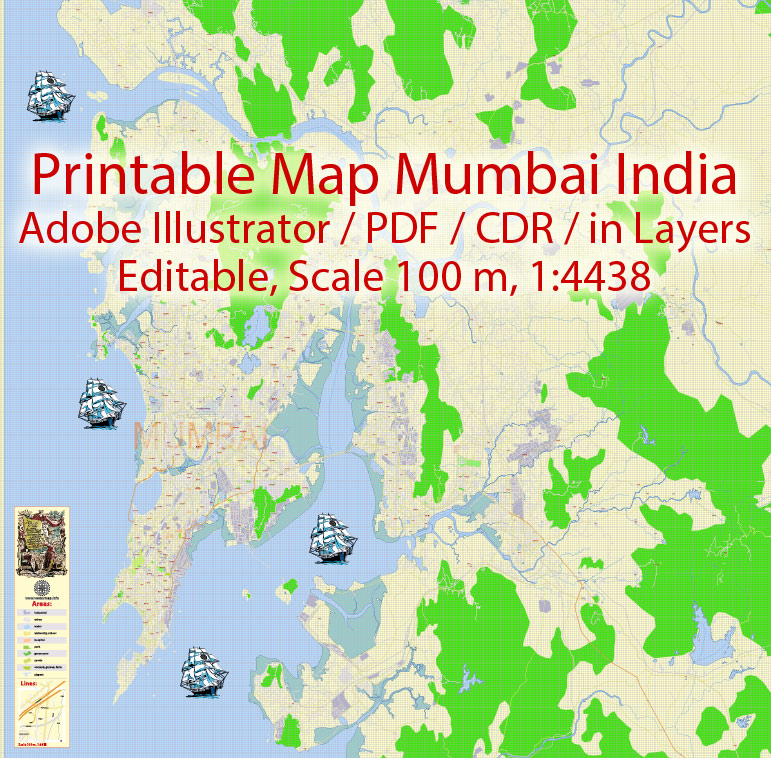
Related Video "Urban plan India":
Related Images "Urban plan Mumbai India":
Mumbai Vector Maps: Editable Cartography Product, Correct Geospatial Data
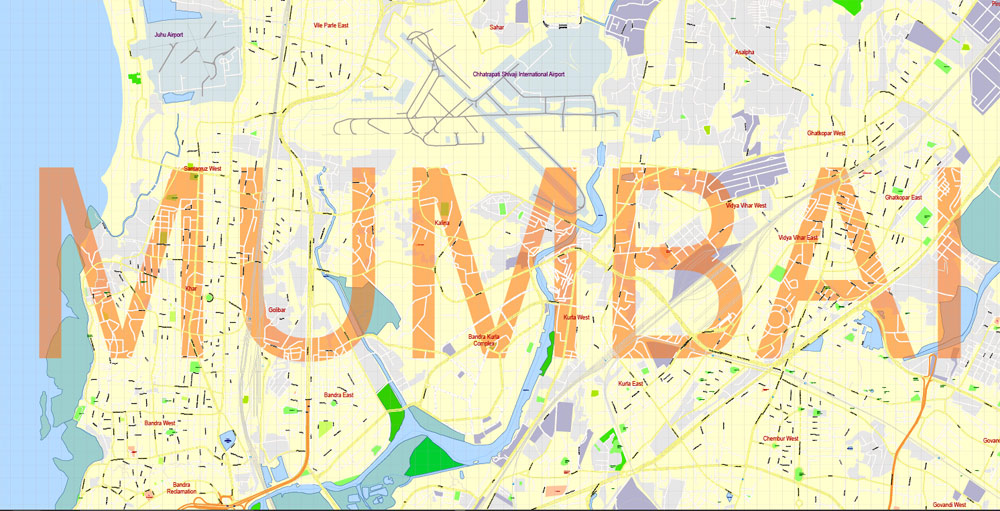
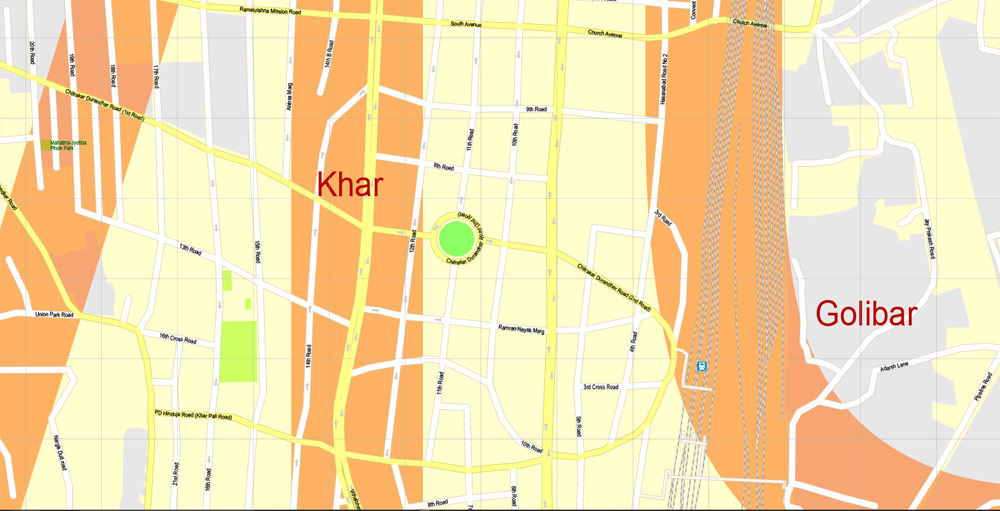
Urban plan Mumbai India: High Detailed Digital Cartography
MUMBAI (before 1995 - Bombay), a city in western India, is the administrative center of the state of Maharashtra.
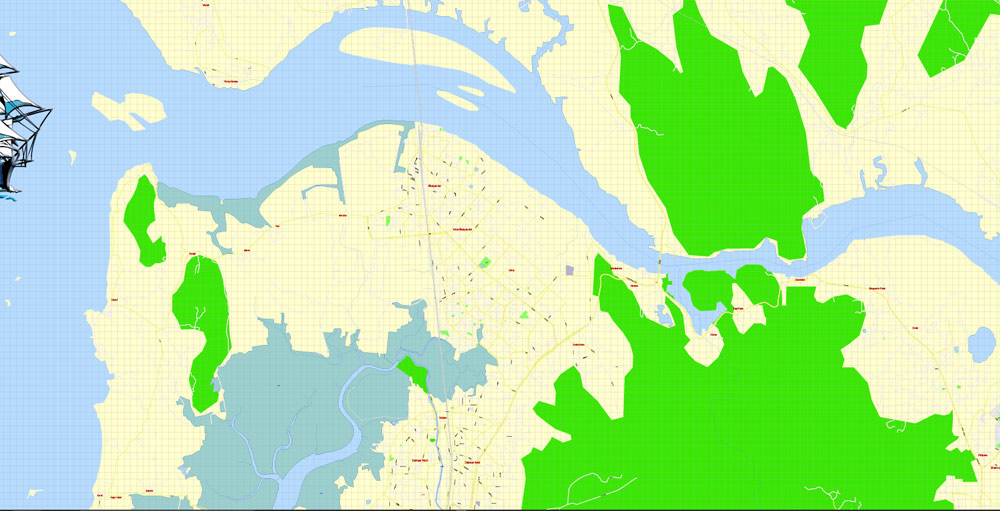
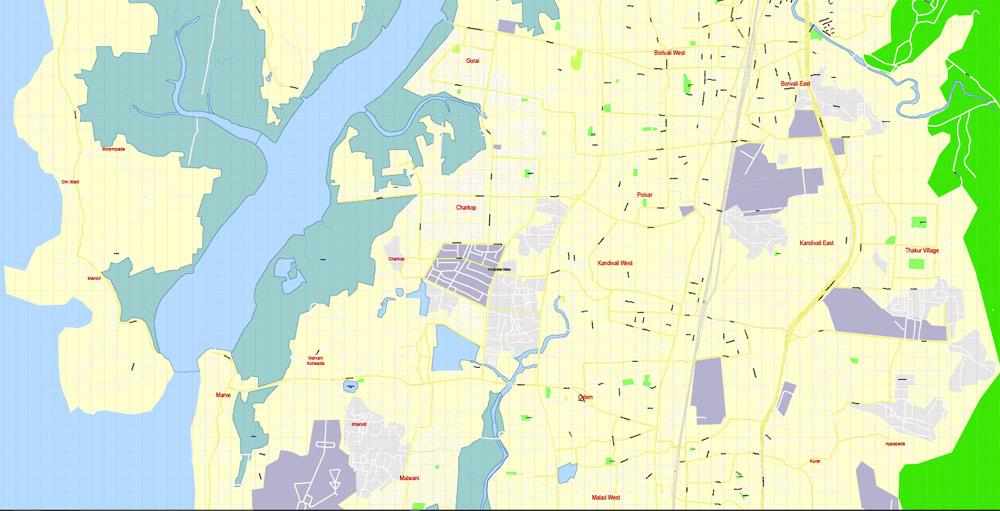
It is located on the coast of the Arabian Sea, originally on the archipelago of the "Seven Islands of Bombay" (later the straits between them were filled in, now represent a single landmass), including the Mumbai City district - on the islands of Solsett and Bombay (now separated from the mainland by the Mahim River (Mithi), as well as the Bay of Bombay (Mumbai), or Mumbai Bay; the height of the central part of the city is 14 m), the suburbs – on other islands and the adjacent part of the mainland.
Transport and geographical location
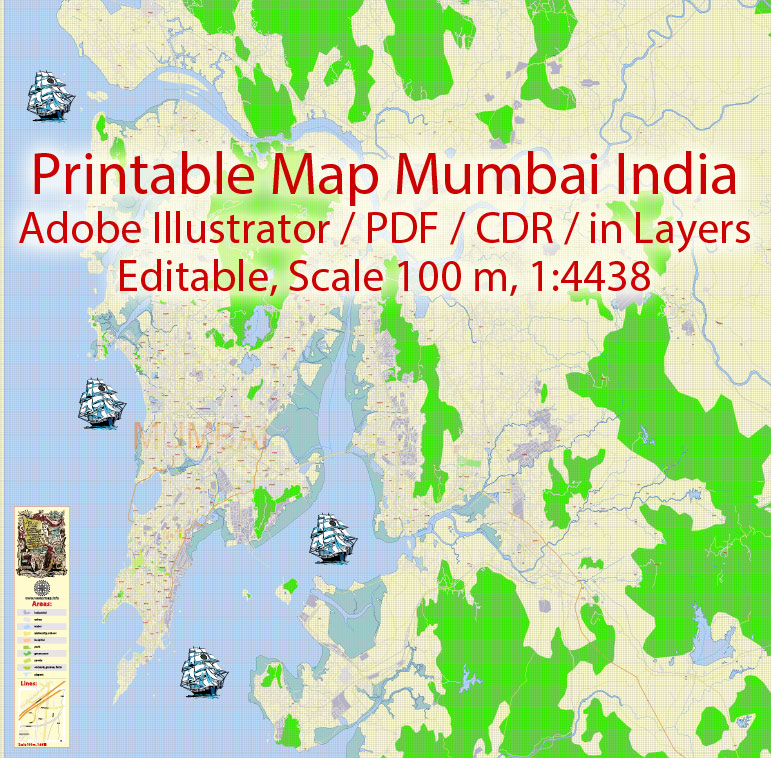
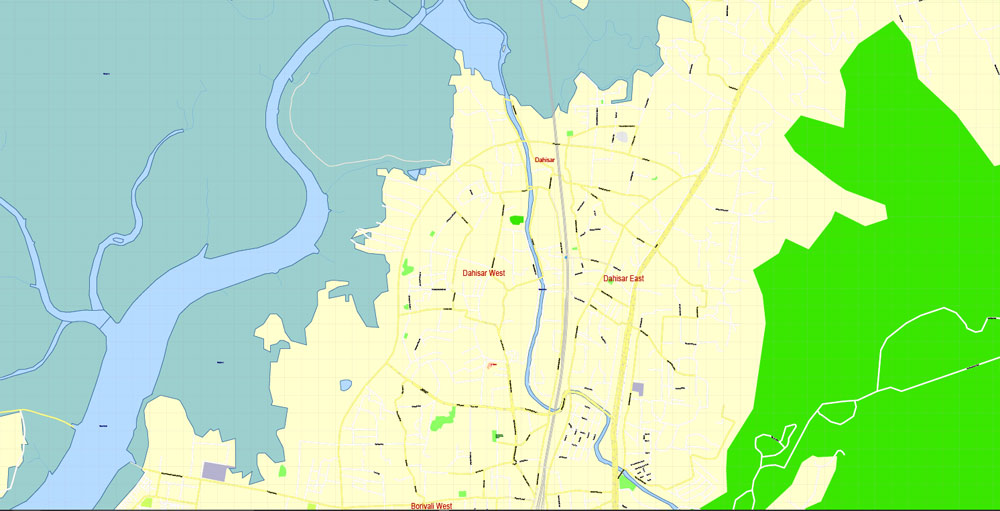
The largest transport hub of the country. Within the framework of the Golden Quadrangle project, it is connected by highways and railways to Delhi, Kolkata and Chennai. Mumbai – Pune Expressway (2002, the first construction in India; length 94.5 km). High-speed six-lane highways connect the city with Delhi (1,419 km long) and Chennai (1,290 km). Highways originate here: Mumbai - Agra, Mumbai - Adilabad, Mumbai. - Cochin, Mumbai - Nasik, Mumbai - Vadodara (the latter is under construction; length 380 km). Highways play an important role for the agglomeration: Chembur – Thane, Bandra–Dahisar and Sion–Panvel. A cable-stayed automobile bridge named after him was built across Bombay Bay. Rajiva Gandhi (2010; provides the connection of Mumbai with the suburbs on the east coast of Bombay Bay; length 5.6 km) and the Vashi Dam (connects Mumbai with the northern mainland suburbs; 1.8 km).
A major railway junction; regular rail service to most of the country's cities. Railway lines: Mumbai - Pune - Solapur - Wadi - Hyderabad, Mumbai - Manmad - Bhopal - Delhi, Mumbai - Surat - Kota - Agra, etc. Several major railway stations and stations: im. Chhatrapati Shivaji (formerly Victoria; 1887; one of the busiest in the country; 18 platforms), Churchgate (1896; 4 platforms), Central Station (1930; 9 platforms), Andheri (1934; 9 platforms), Dadar (1968; 14 platforms), Lokmanya (1991; 5 platforms), Bandra (1992; 5 platforms) and Borivali (9 platforms; all are electrified). The system of suburban railway communication is developed (St. 2.2 billion passengers, 2014; one of the busiest in the world). A special cargo corridor (1,483 km long) connects Dadri in Uttar Pradesh (near Delhi) with the seaport named after him. Jawaharlal Nehru (near Mumbai).
Two major seaports: Port Mumbai (1880; on the west coast of Bombay Bay, in Mumbai City District; includes cargo and passenger terminals; transshipment of petroleum products 61.7 million tons, 2014/15) and port im. Jawaharlal Nehru (1989; on the east coast of Bombay Bay, opposite the port of Mumbai; cargo turnover of 62.4 million tons, 2013/14, including 4.5 million TEU containers, about 60% of the country's container shipping). There is a ferry service through Bombay Bay. Navigation on the rivers Mahim, etc. International Airport named after Chhatrapati Shivaji (1942; 36.6 million passengers in 2015; the Mumbai– Delhi air transportation direction is among the 10 busiest in the world); it is planned to build a new international airport. Juhu Airfield (1928), where the flying club is based. Monorail system (2014). Metro (2014).
Population
The population is 12.5 million people (2011, census; 2.9 million people in 1950; 9.9 million people in 1991), the largest in terms of the number of inhabitants in the country. Together with numerous suburbs [the largest: northeastern Thane (Thana; population 1886.9 thousand people, 2011), Kalyan-Dombivli (1246.4 thousand people) and Bhiwandi (1125.9 thousand people), eastern Navi-Mumbai (1119.5 thousand people) and northern Mira-Bhayandar (814.7 thousand people)] forms a Large Mumbai agglomeration. (administratively divided into 8 municipal corporations, 15 municipal cities, 7 non-municipal urban centers, and 995 villages, 2014) with a total area of 4,355 km2 and a population of 18.4 million people (2011; 20.7 million people in 2016, estimate; 4th place in the world). Mumbai proper (metro region of Mumbai) consists of 5 parts: districts of Mumbai City (or Southern Mumbai; area 157 km2; population 3085.4 thousand people, 2011) and Suburban, as well as parts of the territory of the districts of Thane, Raigad, and Palghar.
History
The name of the city comes from the name of the goddess Mumbadevi, revered by local fishermen. At various times, the territory of modern Mumbai, which included coastal islands (Bombay, Worli, Kolaba, Mazagaon, Maly Kolaba, Mahim, Parel), was part of the Maurya Empire, the states of Satavahans, Chalukyas, Rashtrakuts, Yadavas and sultanates of Gujarat. In 1534 the Portuguese took possession of the islands, in 1661 they were transferred to the British King Charles II Stuart as part of the dowry of Infanta Catherine of Braganza. In 1668, Charles II leased the islands to the British East India Company. In 1717, a trading post and a fort were built, around which the port city of Bombay was formed. In 1773-1937, the capital of the presidency of the same name. In 1817-62, the space between the islands was drained, and they were united into one - the island of Bombay (now forms the Southern Mumbai). The rapid growth of suburbs began, which was facilitated by the laying of the first railway in 1852. Bombay - Thanet. In 1885, the Indian National Congress was established in Bombay; in 1942, the "Get out of India!" movement began here, and in 1946 there was an uprising of sailors. In 1937-50 Bombay was the administrative center of the province of the same name, in 1950-60 it was the state, since 1960 it has been the administrative center of Maharashtra. In 1950, Old Bombay (now Mumbai City District) was merged with the Suburban District into the Bombay City Corporation (now Greater Mumbai). In 1972, to decentralize the city and reduce the load on its port, a satellite city was founded - New Bombay (now Navi Mumbai). In 2008, a series of terrorist attacks were committed in the city, as a result of which 195 people were killed and about 300 people were injured.
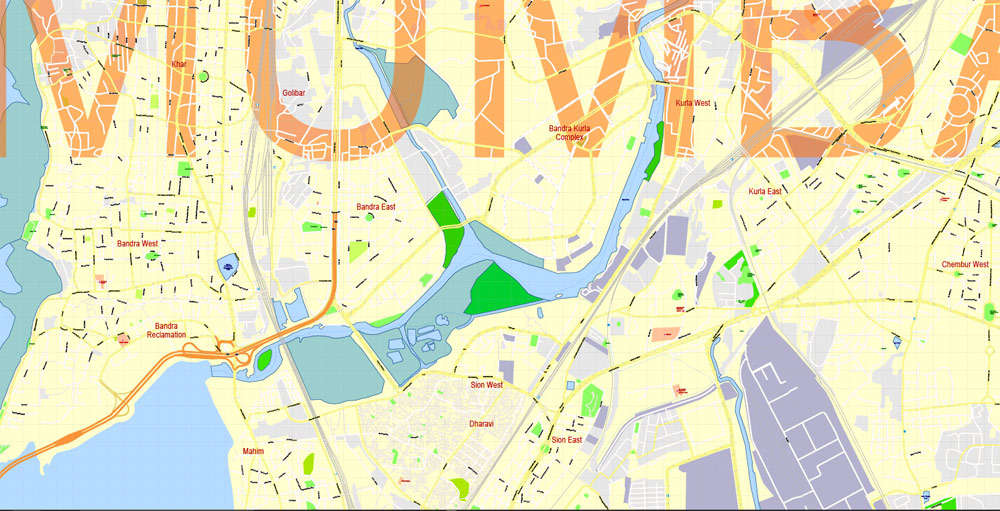
Architecture
On the island of Bombay, the main of the seven original islands of the city were built: a Portuguese fort (16th century, fragments have been preserved), the Anglican church of St. Thomas (now a cathedral; 1672-1718; a neo-Gothic tower - 1838 and a chapel - 1860), a customs building (1714, built-in 1895), in the neoclassical style - the building of the city administration (1820-35, architect T. Cowper; now the Asiatic Society Mumbai), mint (1824-27, architect J. Hawkins). On the island of Parel, there is a Jesuit monastery (1673, rebuilt; since 1719 the governor's residence; since 1899 an anti-plague laboratory, since 1925 the Institute of Bacteriology. V. A. Khavkina) and the English forts of Zion (1669-77) and Sevri (1680). There is an English fort on Worley Island (circa 1675, rebuilt). There is an English fort on the island of Mahim (1669, fortified in 1684; ruins have been preserved). On the island of Kolaba there is an observatory (1826) and an early Neo-Gothic so-called Afghan Church (St. John the Evangelist, 1847-58; in honor of those who died during the English-Afghan War of 1838-42).
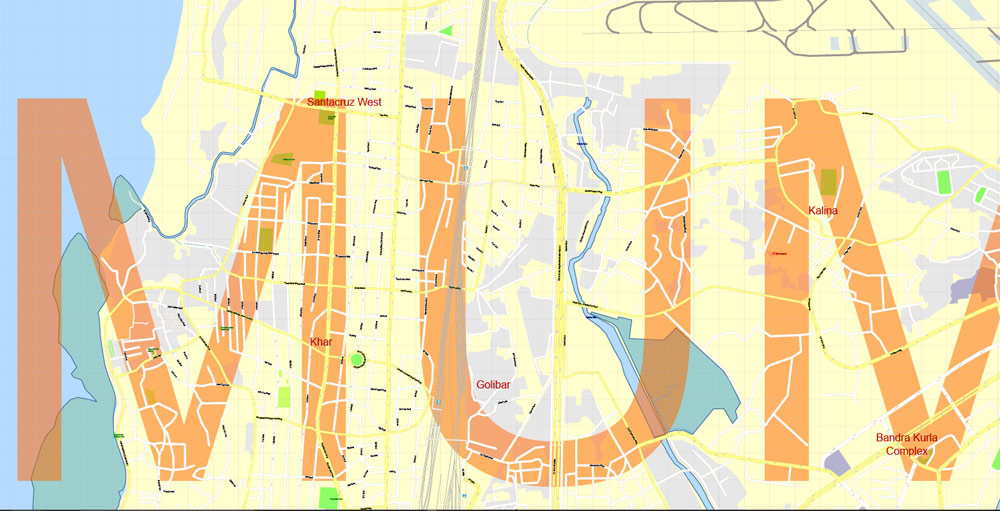
Located in the southern part of the city, the old urban areas of Kolaba, Kala-Ghoda, and Fort (on the site of the English fortress of the late 17th century - 1720s, dismantled in 1864) with the correct layout and wide streets were built up mainly in the last third of the 19th century. 20th centuries. in the spirit of the Victorian style (mainly English Neo-Gothic, often in the spirit of national Romanticism with elements of individual architecture of the 15th-18th centuries): the former Watson's Hotel (built in 1867-69 from cast-iron structures made in England, engineer R. M. Ordish), the Old Secretariat (1867-74, architect G. St. Clair Wilkins), Crawford Market (1869-71, architect W. Emerson; relief by sculptor J. L. Kipling), D. Sassoon Library (1870), Art School building (1877; now Jamshetjee Jeejeebhoy Art School); Royal Sailors' House (now City Council building; 1872-76, architect F. W. Stevens) with Wellington Fountain (1865); neo-Gothic railway station "Victoria" (since 1998 - named after Chhatrapati-Shivaji) using ceramic tiles, stained glass windows (1878-87; included in the World Heritage List; see illustrations for the article India), the building of the Bombay City Corporation (now the Big Mumbai; 1884-93; both with elements of the Indo-Saracen style, architect Stevens), Churchgate Railway station (1894-96, architect Stevens); new post office in the Indo-Saracen style (1904-13, architect J. Begg).
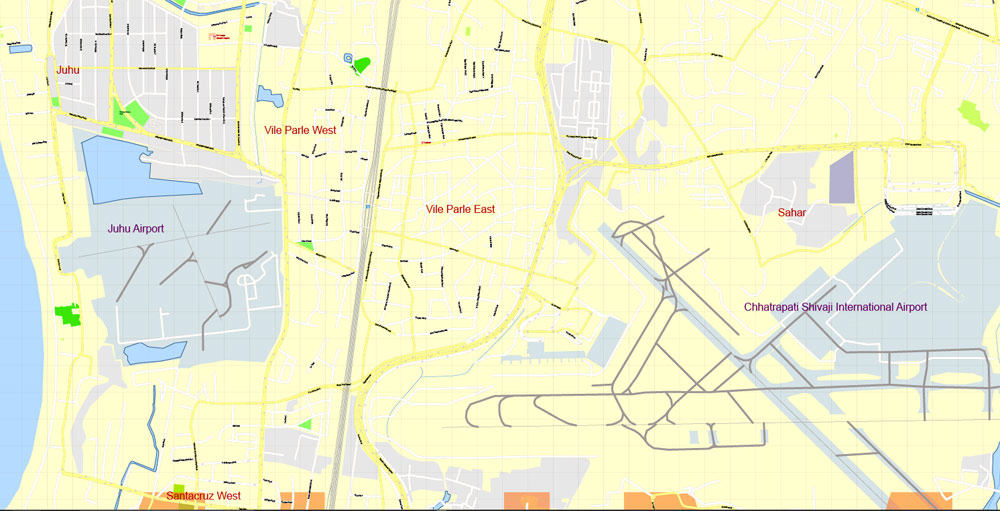
At the same time, buildings of the State Department of Public Works (1869-72, architect G. St. Clair Wilkins), Mumbai University (Assembly Hall, 1869-74; library with Rajabai Clock Tower, 1869-78, both architect G. Scott; administration buildings 1952), Mumbai Elphinstone College (1871), Telegraph Office (1871-74), Supreme Court ( 1871-79), the New Indian Insurance Company, the Museum. Chhatrapati Shivaji Maharaj Vastu Sangrahalaya in the Indo-Saracenic style (1909-15, architects J. Whittet, J. Begg; extensions 1937), the Institute of Science (1911-20, architect Whittet; now at the University of Mumbai). On the shore of Bombay Bay, there is the Taj Mahal Hotel (1899-1903, architect W. Chambers) and the triumphal arch "Gate of India" in the spirit of Gujarati architecture of the 16th century (1914-24, architect Whittet). Along the eastern shore of South Mumbai, there are warehouses, docks (started to be built in 1736; rebuilt in 1875-1905), piers, residential quarters of the former "Black City", the Parel industrial district; along the western shore there are rich neighborhoods with villas, the Malabar Hill district with the Hanging Garden Park (1880), five so-called towers of Silence for the funeral rite of the Parsis. Among other religious buildings preserved: Hindu temples (Valkeshwar, 1127, destroyed in the 16th century, rebuilt in 1715; Mumbadevi, 1753; Babulnath, 1780, spire – 1900; Mahalakshmi, ca. 1785; Siddhivinayak, 1801; Bhuleshwar, 19th century; Surya-Narayan, 1899; etc.), mosques (Haji Ali, 1431, rebuilt; Jama Masjid, 1775-1802), Raudat- Taher; Christian churches (Armenian Church of St. Peter, 1796; Neo-Gothic Catholic Cathedral of the Holy Name of Christ, 1905; Catholic Church of Our Lady Gloria, 1910s), Parsi Temple (1790), synagogues (Knesset-Eliyahu, 1884, etc.), Jain temple (1904).
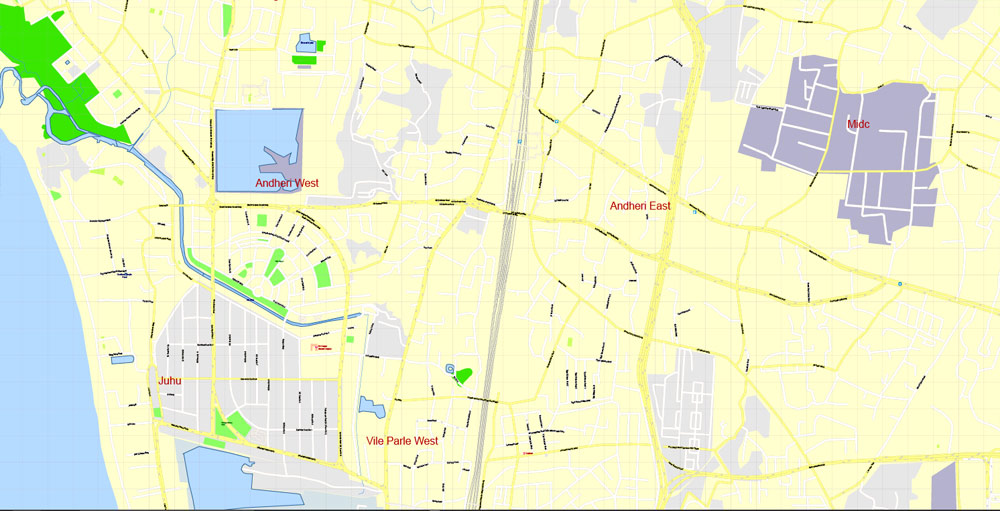
In the 1920s and 30s, residential and public buildings in the Art Deco style were built (including on the Marine Drive highway, laid in 1920 along Buck Bay, as well as on Churchgate Street), cinemas "Eros" (1935-38) and "Metro" (now Metro INOX; 1938, architect T. Lam). With ser. 20th century. (according to the 1948 plan) the city is expanding to the north and northeast, buildings are being built in line with modernism and postmodernism: Taraporevala Aquarium (1951); Church of the Archangel Michael in the Makhim district (1973), artists' quarter in the Belapur district, Kanchanjunga residential building (1970-83; all - architect Ch. Correa); the complex of the Indian Institute of Technology Bombay (1961-66, built with the help of the USSR), the development of the Nariman Point quarter (since the 1970s), the Bombay Stock Exchange building (1980), the bridge over the Mahim River between the Bandra and Worli districts (2000-09), the 27-story private residential building "Antilia" (2003-10; architectural bureau "Perkins & Will"; height 173 m), two 60-storey skyscrapers of the Imperial quarter (2005-10; architect Hafiz Contractor; height 210 m).
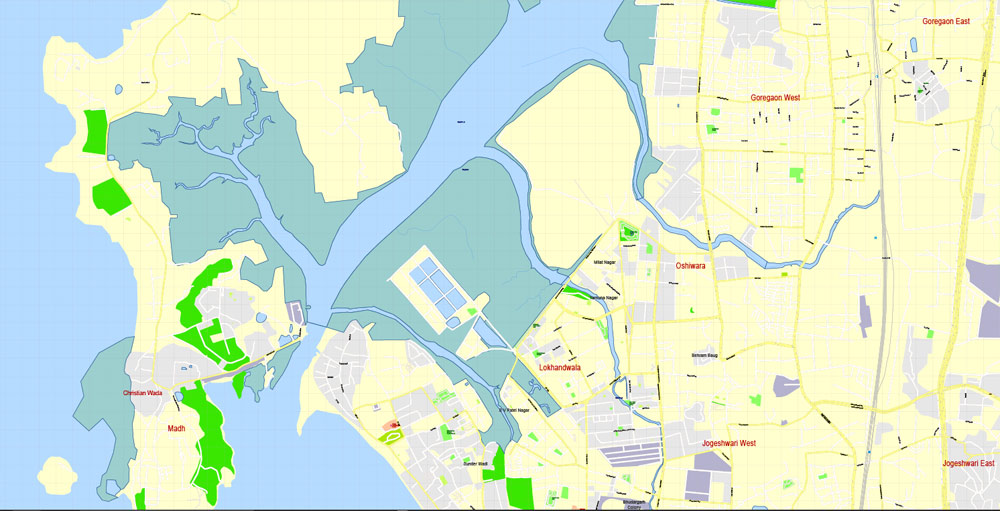
In the Suburban district of Mumbai: in the National Park named after Sanjaya Gandhi – Buddhist temple complex (in 109 caves of Kanheri; 3rd century BC – 9th century AD), Tulsi and Vihar lakes; also Powai Lake; in the area of Jogeshwari – Buddhist cave temples (6th century AD); in the area of Andheri – the ruins of the Portuguese church of St. John the Baptist (1579); in the area of Bandra – the Portuguese church of the Apostle Andrew (1575), the ruins of the Portuguese fort Castello de Aguada (1640), the temple of the Parsees, the Neo-Gothic Catholic basilica of Mount Mary (1760); on the island of Madh - a Portuguese fort (17th century). In Bombay Bay there is Elephant Island with cave temples included in the World Heritage List. A significant part of the territory of Mumbai (mainly in the north) is occupied by slums, where St. 1/2 of the city's population lives.
Science and education
Mumbai is a major center of science and education in India. Among the leading scientific institutions: Institute of Science (1920; former Royal Scientific Institute; research in mathematics, physics, chemistry, biology and biotechnology, as well as postgraduate education); Institute of Fundamental Research "Tata" [TIFR; 1945; one of the leading research centers of the country; research division of the company "Tata Group", under the patronage of the Government of India and the Department of Atomic Energy; as part of the University of Mumbai; the head campus is located in the Kolaba area; Within the framework of TIFR, there are several research institutions: the Center for Scientific Education "Homi Bhabha" in the Deonar district (named after the Indian physicist H. Baba), the National Center for Radio Astronomy in Pune (with the world's largest radio telescope) and the National Center for Biological Sciences in Bangalore]; the Center for Atomic Research "Bhabha" (1954; the largest in Foreign Asia; operator of several research reactors; in the Trombey area). A number of scientific societies, associations and unions; including the Asian Society of Mumbai (1804), the Natural History Society (1883), the Mumbai Medical Union (1883) and the Anthropological Society (1886).
Mumbai universities are considered one of the most prestigious not only in India but throughout Asia. Mumbai University, 1857, is the first state university in India and one of the largest in the world in terms of the number of students; it consists of: V. A. Khavkin Institute of Bacteriology, Veermata Jijabai Institute of Technology (1887), Jamnalal Bajaj Institute of Management (1965); Jamshetjee Jeejeebhoy School of Arts (1857); Seth Medical College (1926; affiliated with King Edward's Hospital); etc. Women's University (SNDT; 1916; only women study). Institutes: Chemical Technology (1933), Social Sciences (TISS, 1936), Indian Technological Bombay (1958; leader in the ranking of Indian universities in 2014), National Industrial Engineering (NITIE; 1963), Management and Business Studies "S. P. Jain" (1981; one of the best business schools in the country), etc. Colleges: State Law (1855; one of the leading in India), Commerce and Economics "Sydenham" (1913; the first of its type in Asia), engineering "Thadomal Shahani" (TSEC, 1983), Engineering and Technology "Vivekananda" (VESIT 1984); State Medical "Grant" ("Grant"; 1845; one of the leading in the country), etc.
There are three dozen libraries in Mumbai. One of the largest and oldest in the country is the Public Library of the Asiatic Society (1833; St. 100 thousand volumes, about 15 thousand of them are rare, including one of the two known surviving originals of Dante Alighieri's "Divine Comedy"; approx. 3 thousand ancient manuscripts; a large collection of coins).
Museums
Among the leading museums of Mumbai is the Chhatrapati Shivaji Maharaj Vastu Sangrahalaya Museum (founded in the beginning. 20th century; former Prince of Wales Museum; the main one in the city; St. 50 thousand artifacts of ancient Indian and foreign culture; includes three sections: art, archaeological and natural science); Museum named after Bhau Daji Lada (1855; former Victoria and Albert Museum; collections of archaeological finds, historical photographs, pottery, clothing, manuscripts, etc.), the Mani Bhavan Museum (the memorial apartment of M. Gandhi, in which he lived in 1917-34; it includes a library); the Scientific Center named after J. Nehru (1972; originally a Scientific and Technical Museum; the largest profile museum of the country; it includes the Nehru Planetarium, 1977), the Museum of the Human Body "Antarang" (2002). National Gallery of Modern Art (1954; the leading art gallery of the country; St. 14 thousand exhibits); art gallery "Jehangir" (1952); Gallery of Modern Indian Art (1990).
Gallery of Images "Urban plan Mumbai India":
City Maps of Mumbai: Urban planning in India
Urban Plan of the Mumbai, India: Digital Cartography
Mumbai India, Editable Digital Vector Maps
Planning for Mumbai: Digital Cartography Development
- Urban plan Charleston West Virginia PDF
- Urban plan Kansas City Missouri PDF
- Urban plan Salt Lake City Metro
- Urban plan Bremen Germany PDF
- Urban plan Tver pdf
- Urban plan Topeka Lawrence Kansas PDF
- Urban plan Terre Haute Indiana ai
- Urban plan Graz Austria
- Urban plan Munchen Germany
- Urban plan Jerusalem Israel Hebrew PDF
- Urban plan Auckland New Zealand
- Urban plan Liege Belgium PDF 13
- Urban plan Perth Australia
- Urban plan Krasnoyarsk PDF Russia
- Urban plan Boise Idaho PDF
- Urban plan Edinburgh Metro Scotland
- Urban plan San Francisco Bay California
- Urban plan Liege Belgium PDF
- Urban plan New York City 15 PDF
- Urban plan Victoria Canada
- Urban plan Denver Colorado 3 10 PDF
- Urban plan Milwaukee Wisconsin low
- Urban plan Dortmund Germany ai
- Urban plan Pskov Russia
- Urban plan US Main Roads
- Urban plan Dominican Republic Detailed PDF 125
- Urban plan Tampere Finland PDF
- Urban plan Geelong Australia PDF
- Urban plan Gdansk Poland
- Urban plan Irkutsk PDF Russia
- Urban plan Jerusalem Israel Hebrew 12 PDF
- Urban plan Cambridge UK
- Urban plan Omsk
- Urban plan Boston Massachusetts pdf
- Urban plan Albuquerque Rio Rancho New Mexico SVG
- Urban plan Springfield CDR
- Urban plan Greater Miami Florida 4 AI
- Urban plan Brownsville Texas 2 10 PDF
- Urban plan Essen Germany pdf
- Urban plan Toledo Spain
- Urban plan Spokane PDF
- Urban plan Allentown Pennsylvania AI
- Urban plan Aarhus Denmark pdf
- Urban plan Cleveland Ohio CDR
- Urban plan Detroit Michigan CDR
- Urban plan Dominican Republic Detailed a3 AI
- Urban plan Milano Italy
- Urban plan Kiev Metro CDR
- Urban plan full Poland Relief
- Urban plan Raleigh Chapel Hill Durham North Carolina
- Urban plan Montreal Canada
- Urban plan Madrid Spain AI
- Urban plan Baku Azerbaijan PDF
- Urban plan Linggo Sari Baganti Indonesia
- Urban plan Dallas
- Urban plan Haifa Israel pdf
- Urban plan Memphis Tennessee PDF
- Urban plan Austria Vector Relief Roads
- Urban plan Menlo Park California 13
- Urban plan Omaha Nebraska PDF
- Urban plan Orel Russia
- Urban plan Istanbul Turkey ai
- Urban plan Landau Germany ai
- Urban plan Helsinki PDF
- Urban plan Philadelphia Pennsylvania pdf 309
- Urban plan Relief Spain
- Urban plan San Juan Puerto Rico PDF
- Urban plan Nantucket Marthas Vineyard Massachusetts 17 ai
- Urban plan US Canada all roads pdf
- Urban plan Malmo Sweden pdf
- Urban plan New Orleans
- Urban plan Gdansk Gdynia Sopot Poland
- Urban plan Duke University Durham North Carolina PDF
- Urban plan Eugene Oregon
- Urban plan Las Vegas Nevada 3 10
- Urban plan Bremerhaven Germany ai
- Urban plan Tver pdf
- Urban plan Melbourn Australia
- Urban plan Denver Metro
- Urban plan Minneapolis Saint Paul Minnesota CDR
- Urban plan Warsaw Poland
- Urban plan UK Great Britain Admin PDF
- Urban plan Vienna Wien Austria pdf
- Urban plan Saratov Russia
- Urban plan Richmond Virginia
- Urban plan Gdansk Sopot Gdynia Poland PDF
- Urban plan Irkutsk Russia
- Urban plan San Antonio Texas ai