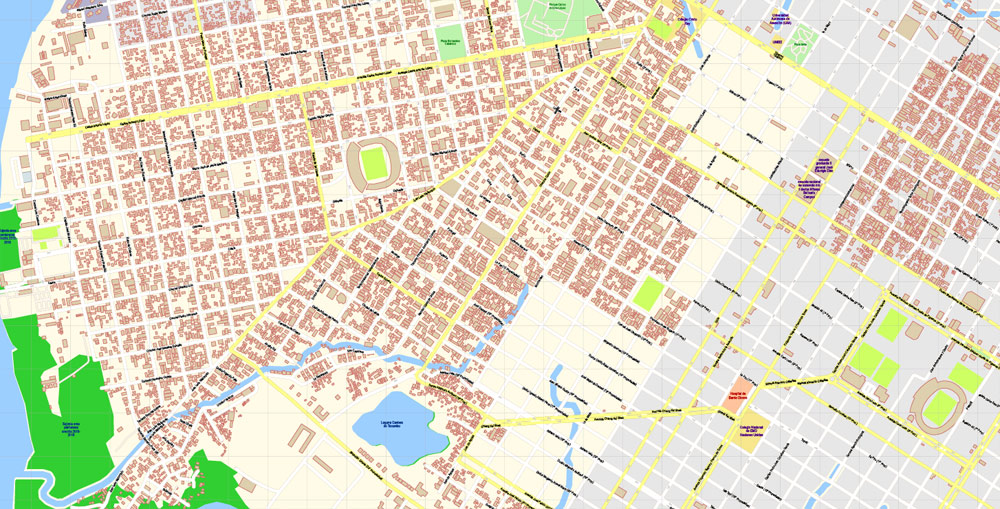
Urban plan Asuncion Paraguay: Digital Cartography
Video: Simple video tutorial HOW TO WORK WITH VECTOR MAPS
Urban plan Asuncion Paraguay: For Tourism, Business and Logistics
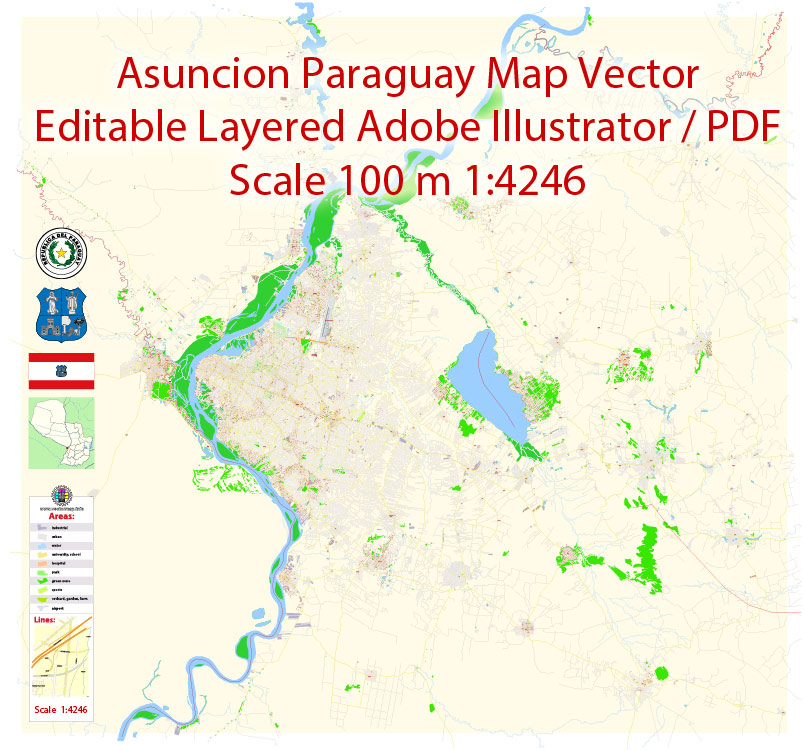
Asuncion is the capital of Paraguay. Statistics say that the number of residents of the city is about 1.5 million people.
Infrastructure of Asuncion. Local providers have a fairly fast connection speed to the World Wide Web, and it should be enough during your stay in Asuncion. The transport situation in the city is complicated by the fact that congestion often occurs on the city's roads, so before traveling by car, you should check information about city traffic. Due to the fact that the crime rate in the city is not particularly low, guests of the city need to be careful during a visit to Asuncion.
The general assessment of Asuncion. Although the city cannot be called an ideal place to live, international quality of life ratings contain good ratings.
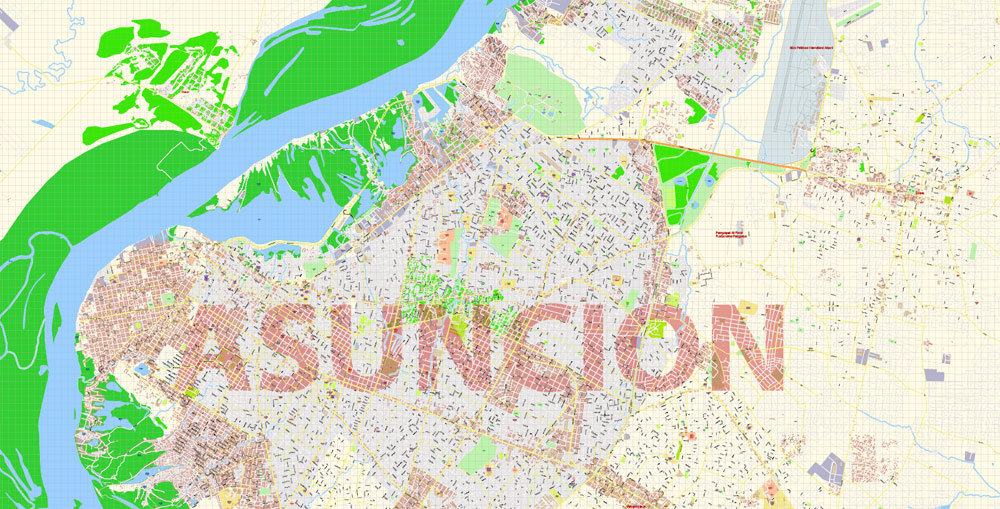
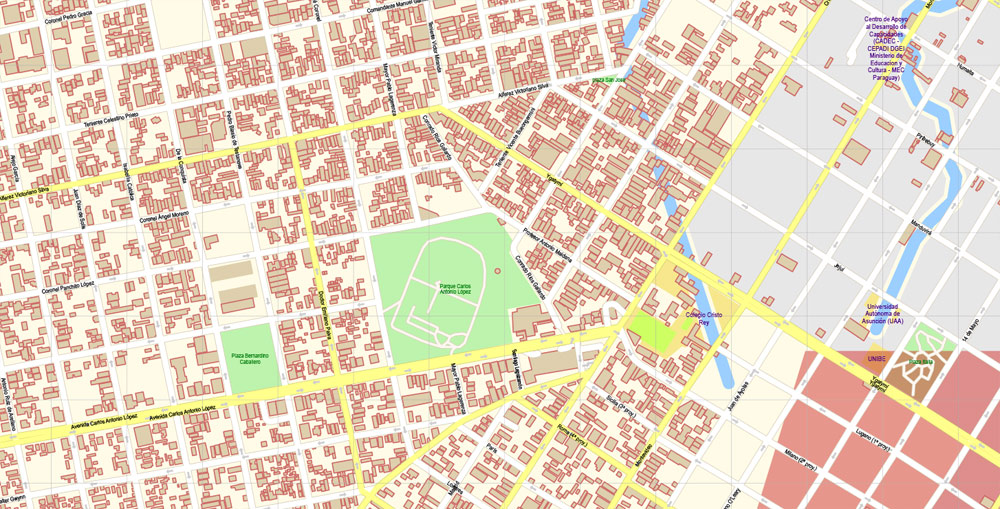
Asuncion is located in Paraguay, this city is the capital of the country. Its main attractions, popular restaurants, and hotels are located in the center, around the squares of Heroes, Democracy, Independence, and Juan Emiliano O'Leary. There is also the National Pantheon of Heroes - the burial place of outstanding Paraguayan politicians and military.
The toponymy of Asuncion was influenced by Russian emigration — in the twenties of the last century, a large number of Russian officers who took part in the Chaka War between Paraguay and Bolivia and became heroes of the republic moved here. The names of General Belyaev, Colonel Butlerov, Captain Blinov, engineer Krivoshein are immortalized in the names of the streets of the city and in the Pantheon of Heroes.
The axis of the area of financial and commercial institutions is Palm Street. At the intersection of the Palm Tree and Columbus Avenue, there is a quarter of souvenir shops of Rekov. To the east of the city center of Asuncion, in the Villa Mora and Recoleta districts, there are residential quarters with elite housing, embassies of other countries, various entertainment venues.
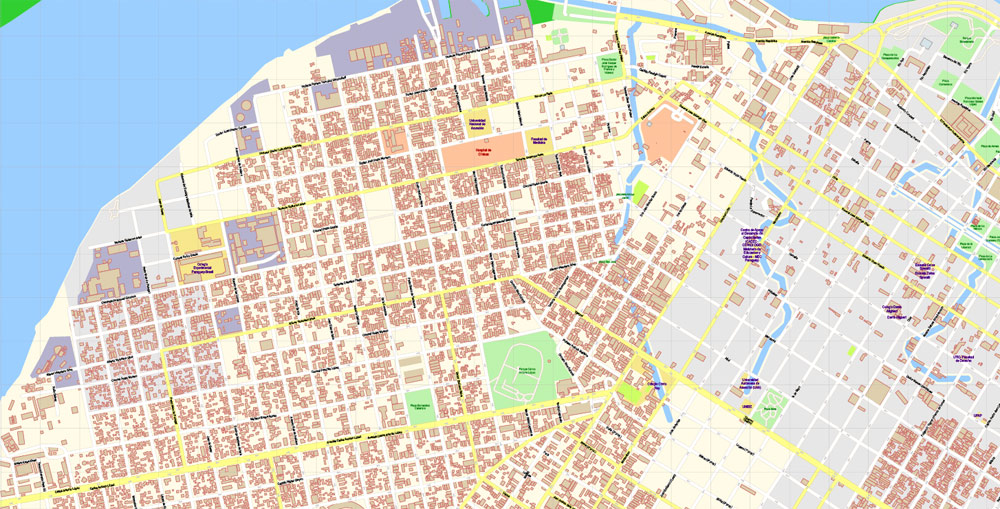
The colonial buildings of Asuncion have been preserved in its coastal area and in the center. Here is the Cabildo Palace, now the Republican Cultural Center, the Cathedral of the Virgin Mary and the buildings of the Jesuit mission, the Presidential Palace, and the Casa de la Independencia House Museum, where the Declaration of Independence of Paraguay was read for the first time.
The cultural and entertainment attractions of the city include the Manzana de la Riviera complex with a museum, two theaters, cafes, and galleries, as well as the Del Barro Museum, which exhibits the best examples of Paraguayan national art. Another place of interest for tourists is the Hardin Botanic Park with museums of Indian culture and natural history, a zoo, and a Maka Indian Reservation.
Geography of Paraguay
The Republic of Paraguay is a landlocked country in South America. It borders Argentina to the south and southwest, Bolivia to the northwest, and Brazil to the east and northeast. It has no access to the sea.
The country is divided into two unequal parts by the Paraguay River. To the west of the river is the Gran Chaco region, a desert region that occupies about 60% of the country's area. In the east, where the bulk of the population is concentrated, there are fertile flatlands and subtropical forests.
State structure
Paraguay is a presidential republic. The head of State and Government is the President. The President is the Commander-in-Chief of the armed forces, appoints the Cabinet of Ministers, and heads of the local administration. The Parliament is a bicameral Congress.
Language
Official language: Spanish, Guarani
The language of the indigenous population, Guarani, is widely used for interethnic communication. 37% of the population speak only Guarani, 50% speak Spanish and Guarani, 7% of the population speak only Spanish and 6% speak German, Japanese or Korean.
Religion
The official religion in Paraguay is Catholicism. About 90% of believers are Catholics, and 10% are Protestants (Mennonites).
Currency
International name: PYG
Guarani is equal to 100 sentimos. Banknotes in denominations of 50,000, 10,000, 5000, 1000, and 500 guarani are used in circulation, as well as coins in denominations of 100, 50, 10, 5, and 1 guarani.
MasterCard, American Express, and Visa credit cards are accepted almost everywhere, with the exception of small hotels. Their use in catering establishments is limited. Traveler's checks in US dollars are accepted almost everywhere, except for small hotels.
Many people are surprised that the capital of Paraguay has a much longer name than the usual Asuncion. The full official name mentions the Virgin Mary herself, the patroness of the city, whom the locals respectfully call "our Lady (Senora)".
The location of the main city of the country is very convenient - on the plain, not far from the meeting point of two rivers - Paraguay and Pilcomayo. The climate is tropical, very hot, and only in winter, the winds from the south bring the long-awaited coolness.
An excursion into history
The name of the founder of the city is known – Juan de Salazar, a conquistador whose roots should be sought in Spain. Also, Paraguayans know the exact date of the foundation of the capital - August 15. On this day, the great Christian holiday is celebrated – the Assumption of the Blessed Virgin Mary, and the name Asuncion means nothing else than the Assumption.
In the Middle Ages, the city was the administrative center of one of the Spanish colonies, and also served as a stronghold of colonizers on the road to Peru. Monks from the Jesuit Order had the strongest influence on the development of the city, almost until 1768 they held power in their hands.
Asuncion became the capital of the independent state only in 1811, although the struggle for independence continued later. During the Paraguayan War, the capital was captured by Brazilian troops, the population decreased significantly, many architectural monuments and attractions were destroyed.
Cultural map of the city
Fortunately, many cultural monuments have been restored, and in general, the historical center preserves the buildings of the colonial period, as well as the majestic religious buildings erected by the hands of hardworking Jesuits during the XVI - XVIII centuries. The most significant sights of Asuncion are called by locals:
National Pantheon of Heroes;
Independence House;
Cathedral;
Gardens - botanical and zoological.
The Pantheon is a memorial dedicated to the famous Paraguayans who gave their lives for the independence of their homeland. In addition, it is one of the most beautiful architectural structures of Asuncion, at the entrance you can see bronze soldiers, and inside there is a majestic sarcophagus, which is covered with the national flag.

Related Images "Urban plan Asuncion Paraguay":
- Urban plan State Florida
- Urban plan Lima Peru 2 parts
- Urban plan Manchester UK
- Urban plan Germany Admin Roads PDF
- Urban plan Milwaukee Wisconsin low
- Urban plan Kansas City CDR
- Urban plan Jakarta Indonesia autocad dwg
- Urban plan Ryazan Russia
- Urban plan Tuscaloosa Alabama
- Urban plan Saint Petersburg Russia
- Urban plan Bern Switzerland pdf
- Urban plan Italy Relief Admin
- Urban plan Boston Massachusetts low PDF
- Urban plan Cartagena Spain
- Urban plan Minneapolis StPaul Minnesota pdf
- Urban plan Prague Czech Republic
- Urban plan Ottawa Canada pdf
- Urban plan Gothenburg Sweden Goteborg Sverige
- Urban plan Montreal and surroundings Canada
- Urban plan Essen Germany
- Urban plan Salt Lake City Metro
- Urban plan Zaragoza Spain pdf
- Urban plan Cincinnati Ohio CDR
- Urban plan Santiago Chile
- Urban plan Sioux Falls South Dakota
- Urban plan Lancaster Pennsylvania PDF
- Urban plan Lawrence Kansas 3 10
- Urban plan Tel Aviv Israel ai
- Urban plan Dominican Republic Detailed PDF 125
- Urban plan Graz Austria PDF
- Urban plan Dominican Republic Detailed a3
- Urban plan Tel Aviv Yafo Israel 12 PDF
- Urban plan Dominican Republic Detailed AI
- Urban plan Tasmania Full Roads
- Urban plan Salt Lake City Utah ai
- Urban plan Havana Cuba
- Urban plan Flagstaff Arizona
- Urban plan Portugal Admin
- Urban plan Rome Italy
- Urban plan Chicago Illinois CDR
- Urban plan Canberra Australia PDF
- Urban plan Smolensk pdf
- Urban plan Tallinn Estonia pdf
- Urban plan Arcata Eureka California PDF
- Urban plan Madison Wisconsin PDF
- Urban plan Rastatt Baden Baden Germany ai
- Urban plan Cardiff Newport Wales UK PDF
- Urban plan New Orleans Louisiana