Urban plan Beijing PDF: Exact Cartography
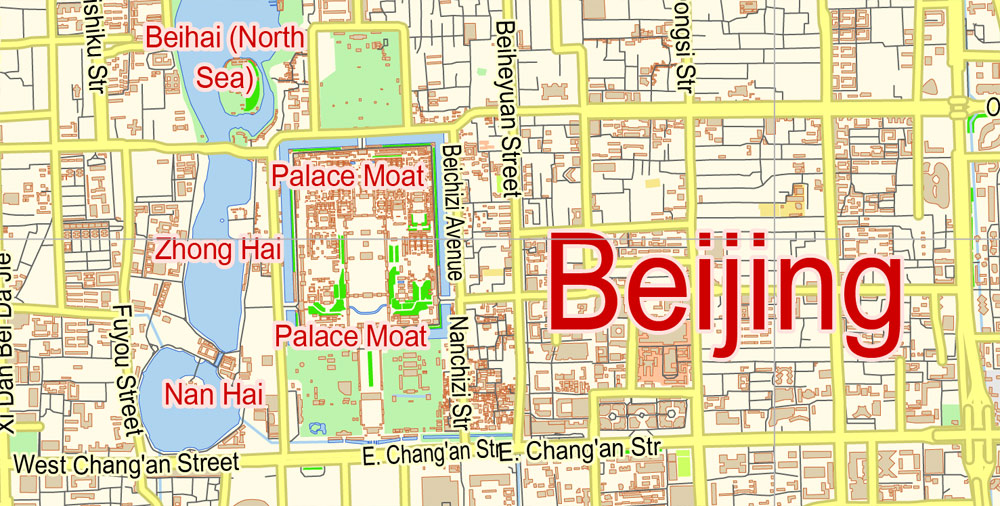
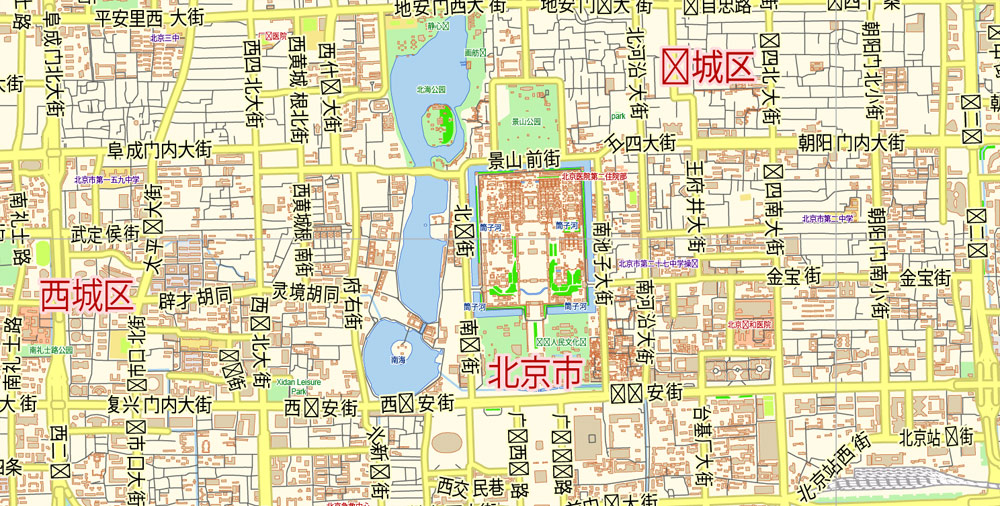
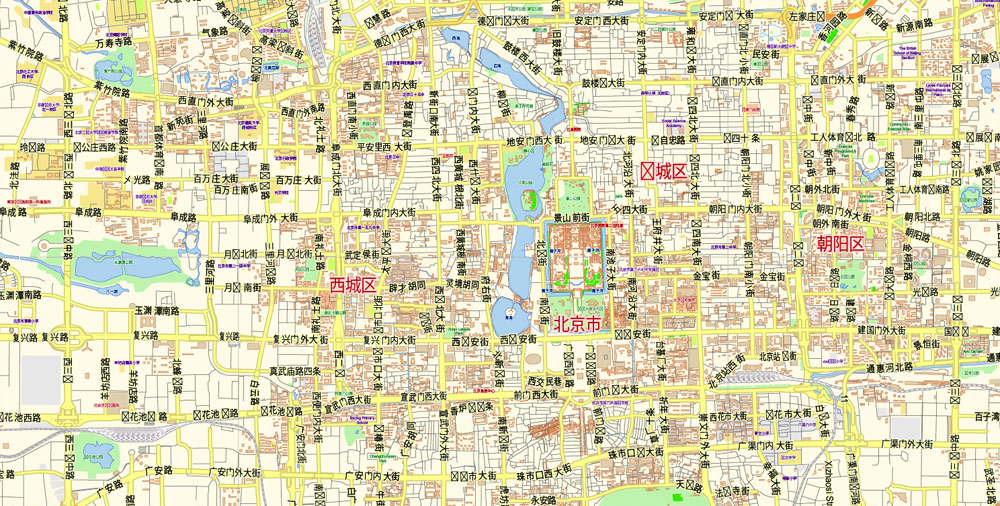
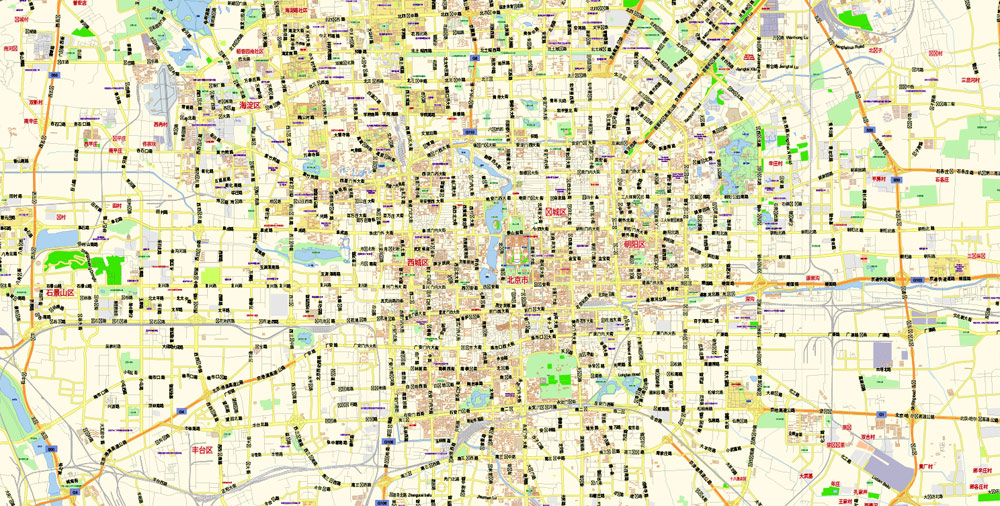
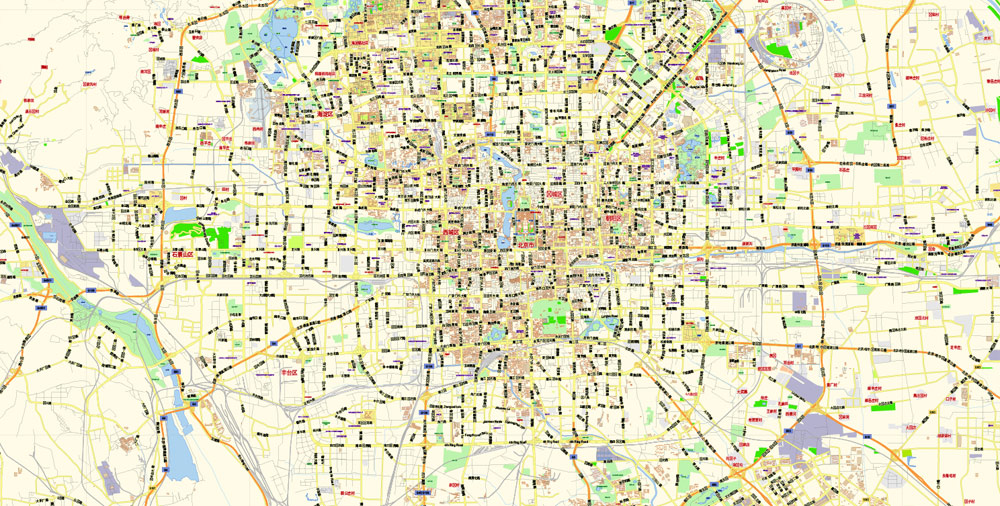
Urban plan Beijing PDF: Editable maps for printing
Huge, noisy, strange, diverse Beijing is one of the oldest capitals of the planet. Its history goes back more than 3,000 years, during which the city was destroyed, burned, conquered, rebuilt, but it has not lost either power or greatness. In the normative pronunciation, the name of the metropolis sounds like "Beijing", which means "Northern Capital". Modern Beijing is the main cultural, political and educational center of China, despite the fact that the country's economic forces are concentrated in Shanghai and Hong Kong.
Beijing is ruled by symmetry: the axial lines passing through the center of the Forbidden City from north to south and from west to east determine the location of local streets and houses. The architecture of the Chinese capital is a bizarre synthesis of the Soviet-style clumsy buildings familiar to every Russian (the Communist Party does not sleep) and the ancient imperial palaces, parks, and temples that are amazing in their beauty. People come here to immerse themselves in the atmosphere of an Asian metropolis, get lost in the endless streets, taste the most delicious duck in the world, and admire the sights. In a word - to touch the legend.
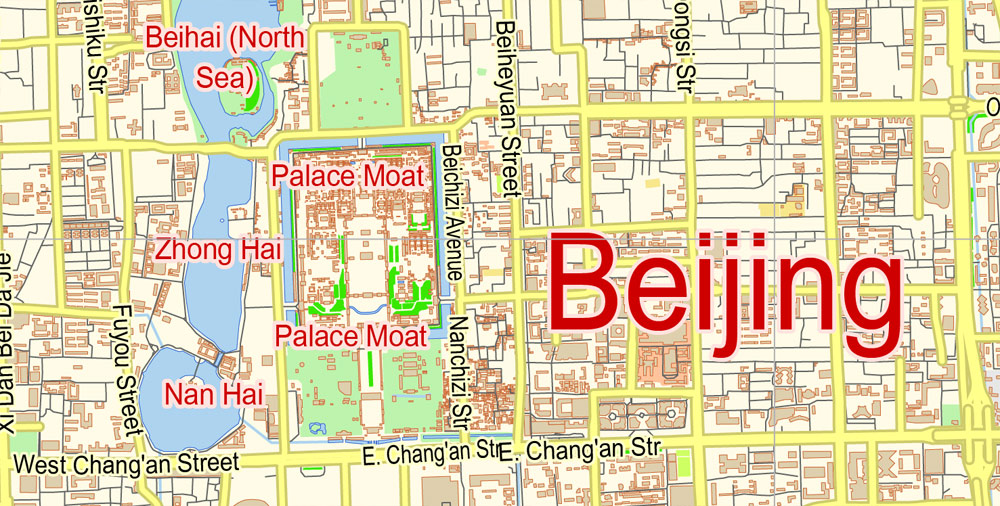
Officially, Beijing consists of 16 county-level units, 8 of which form the urban zone and the nearest suburbs, 6 - distant suburbs and satellite cities, 2 - semi-rural and rural territories.
The heart of the Chinese capital is Tiananmen Square with the Mao Mausoleum and other monuments of national importance. The city center is divided into 4 districts, in which most of the hotels and attractions are located. In the Xicheng district in the northwest are the Beihai Park, the zoo, the Grand National Theater. The northeast Dongcheng district attracts tourists with the secrets of the Forbidden City. In southeastern Chongwen, the Temple of Heaven rises. The "Mast-si" of southwest Xuanwu is the Fayuansa Temple, the oldest in Beijing.
The city is growing so rapidly that there are a lot of problems: air pollution, traffic jams, destruction of historic buildings. In 2005, the authorities decided to limit the expansion of Beijing by concentrating it in two semicircular zones to the east and west of the center.
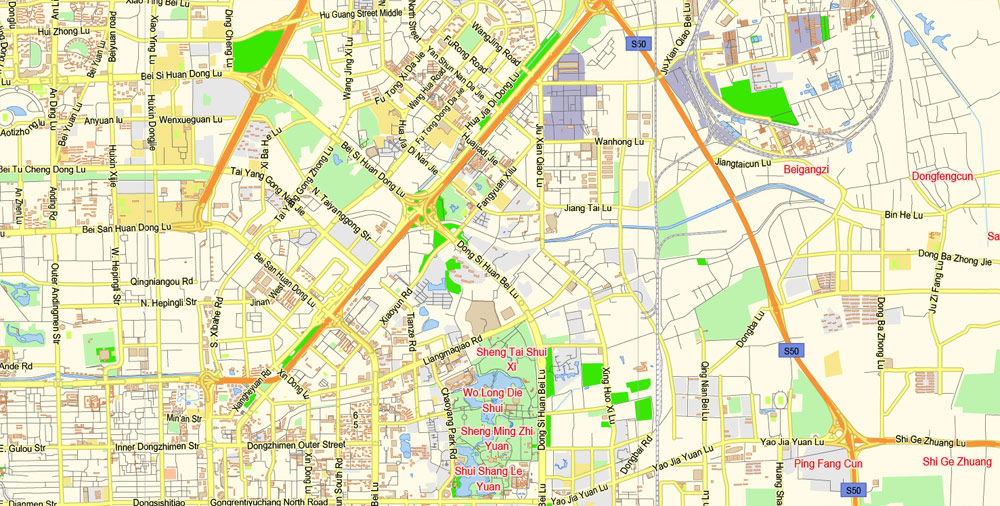
The northeastern Chaoyang district is famous for its business districts, Olympic Park, expensive bars, and restaurants. The largest universities of the country are located in Haidian, as well as the Summer Imperial Palace, the Botanical Garden, and the ruins of Yuanminyuan. The suburbs of Mentougou with Buddhist temples and Fanshan with world-famous archaeological sites are also popular with tourists. Yabaolu quarter is a place of concentration of the Russian diaspora in Beijing
All kinds of hotels and hostels are located all over Beijing. Those in the city center are more expensive, although by Western standards the prices here are quite acceptable. The cost of living in luxury 5* hotels starts from 570 CNY per room.
The golden mean is "treshki", where you can stay for 250 CNY per day. The most interesting accommodation option for fans of Asian exoticism is unusual hotels with rooms made in traditional Chinese style. Most of them are on the outskirts, especially near the Great Wall of China.
Cheap hostels of varying degrees of comfort are concentrated in Dongcheng and Xuanwu districts. This is a historical center, so it is very convenient to settle here. A bed in a dormitory room costs 110 CNY. For those who want to save on accommodation, but do not like hostels, we advise you to pay attention to zhaodaisuo hotels — something like student dormitories. Foreigners are usually not accepted here, but if you speak at least a little Chinese, you can try to negotiate with the staff.
The fastest and most convenient way to get around Beijing is by subway. The local metro consists of 20 lines, the MetroMan app will help you build a route and calculate the trip time. The fare depends on the distance of the trip: 3-6 CNY. The exception is the line connecting the city center with the airport: an express ride will cost 25 CNY.
The ground transport system is extremely complex and extensive, there are more than 600 trolleybus and bus routes in total. Public transport is overloaded, during rush hour it is simply filled to capacity. The ticket price depends on the route: a trip on day buses No. 1-122 and night buses No. 201-212 costs 2 CNY. Buses No. 300-899 (1 CNY for the first 12 km and 0.50 CNY for each subsequent 5 km) and No. 900-949 (1 CNY for every 10 km) run on the outskirts and in the suburbs.
A prepaid smart card "ikatun" will help save money: with it, each trip on routes No. 1-499 will cost 0.50 CNY.
It's easy to get a taxi in the city. You will have to pay 13 CNY for the first 3 km, and 2-3 more CNY for each subsequent one. The car is distinguished by a yellow stripe in the center and a TAXI sign. When traveling long distances (more than 15 km), a fuel fee is charged. The night rate is 30% more expensive than the day rate.
The Chinese are very fond of bicycles, and therefore the bike-sharing system is gaining popularity every year. Hourly payment for services: 1-2 CNY. Basically, the Chinese use two main applications for renting bicycles: Mobike and Ofo. To use bike-sharing services, you need to register and make a deposit of 200-300 CNY. The bike paths here are smooth and comfortable, but the traffic is very chaotic: the locals cannot be called champions in compliance with traffic regulations. The most exotic way of transportation is bicycle rickshaws, taking from 200 CNY for 2.5 hours of travel.
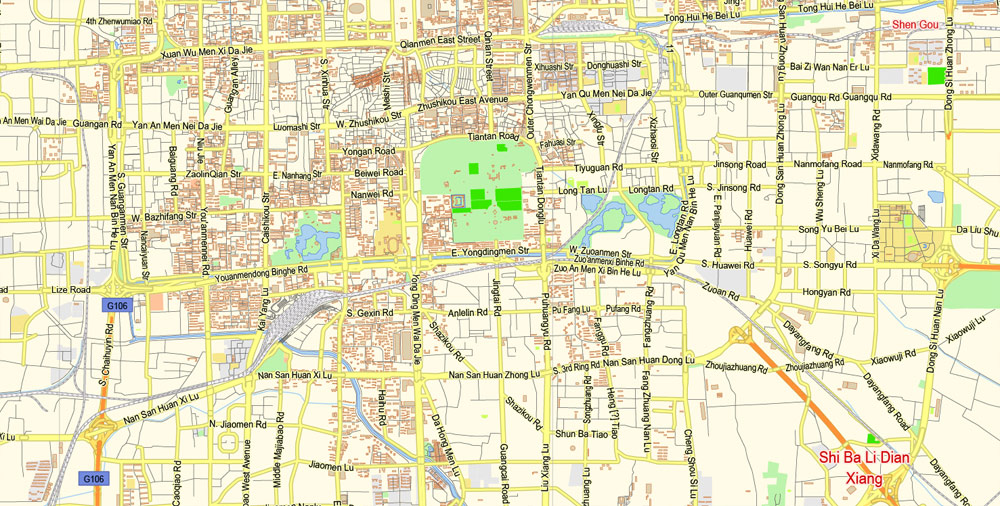
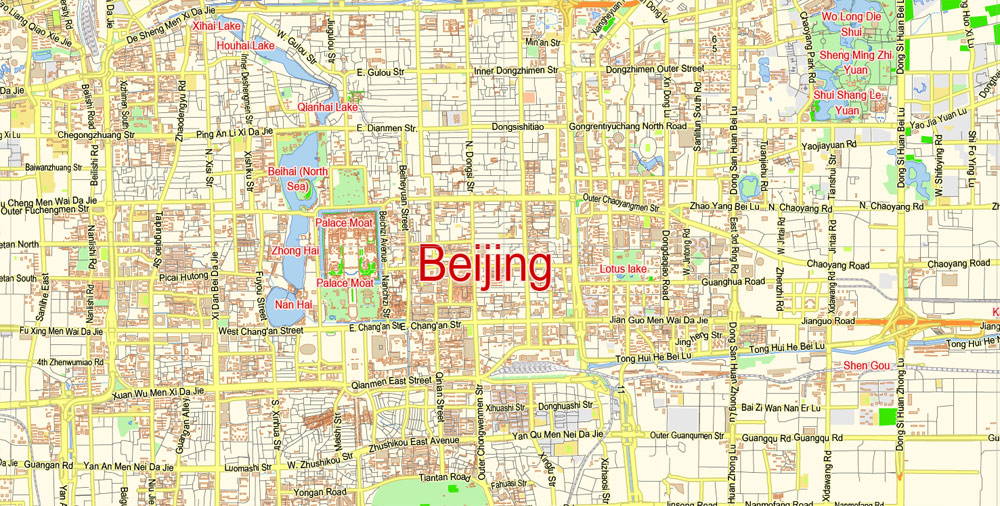
The most famous attraction in Beijing is the Forbidden City of Gugong, the most beautiful medieval ensemble and also the largest palace complex in the world. From the 15th century until the beginning of the last century, it remained the main residence of the Chinese emperors. The Forbidden City is surrounded by a high city wall with corner towers and a wide moat filled with water.
Once the entrance to Gugong was forbidden on the pain of the death penalty, and today there is an Imperial Museum with many pavilions filled with priceless exhibits.
In the very center of Beijing, there is a huge Tiananmen Square. It is here that thousands of spectators gather every morning who want to watch the ritual of raising the national flag. The most important national monuments are located on the square: the Mausoleum of Mao Zedong, the People's Assembly Building, the Museum of the Revolution, the Chinese Historical Museum, the ultramodern Opera House. The heart of Tiananmen is a giant monument in honor of the national heroes of the Republic of China.
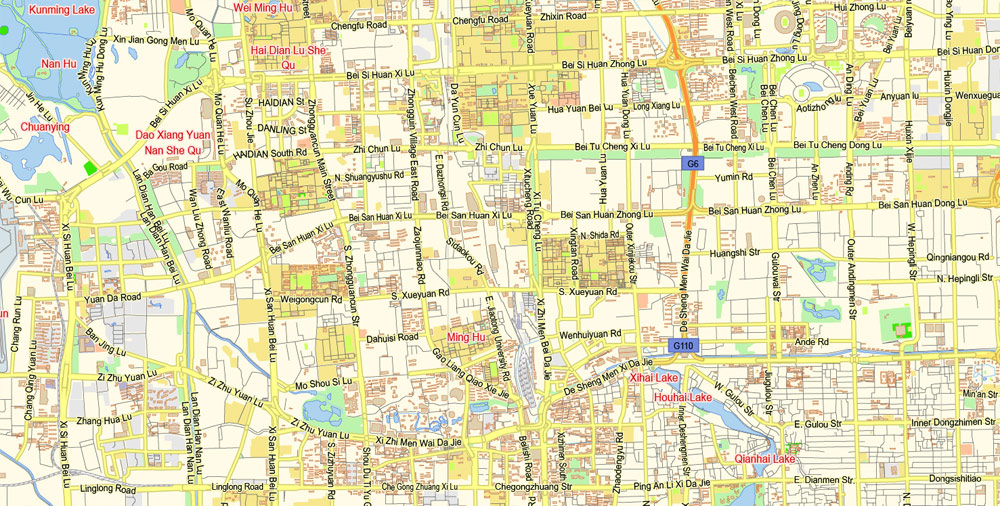
One of the main symbols of the city is the Temple of Heaven, built-in 1420 by order of the ruling Ming Dynasty. Every detail of its decoration has a special meaning: the sky-blue three-tiered roof is supported by 28 pillars, 4 of which symbolize the seasons, 12 months, and another 12 hours. The unique altar of the temple is made of marble slabs, the number of which is a multiple of 9 - digit, endowed with the highest power in Chinese mythology.
The Summer Imperial Palace is a magnificent palace and park complex, also known as the "Garden of Peace and Harmony". Most of its territory is occupied by the picturesque Kunming Lake.
The geographical and cultural center of the Chinese capital is Tiananmen Square.
You should definitely take a walk through the ruins of the former country residence of the Chinese rulers of Yuanminyuan. Its construction began in 1153, and subsequently, the palace was rebuilt many times. Almost all the buildings were destroyed during the fire of 1860, and today you can only admire the remains of the former splendor. Surrounded by artificial lakes and labyrinths of canals, the ruins of Yuanminyuan look almost like antique ones.
The most beautiful religious buildings of the city are the Temple of Confucius, the Temple of the Great Bell, and Yonghegong. Bright, whimsical in shape and richly decorated, they attract crowds of pilgrims and tourists from all over the world every day.
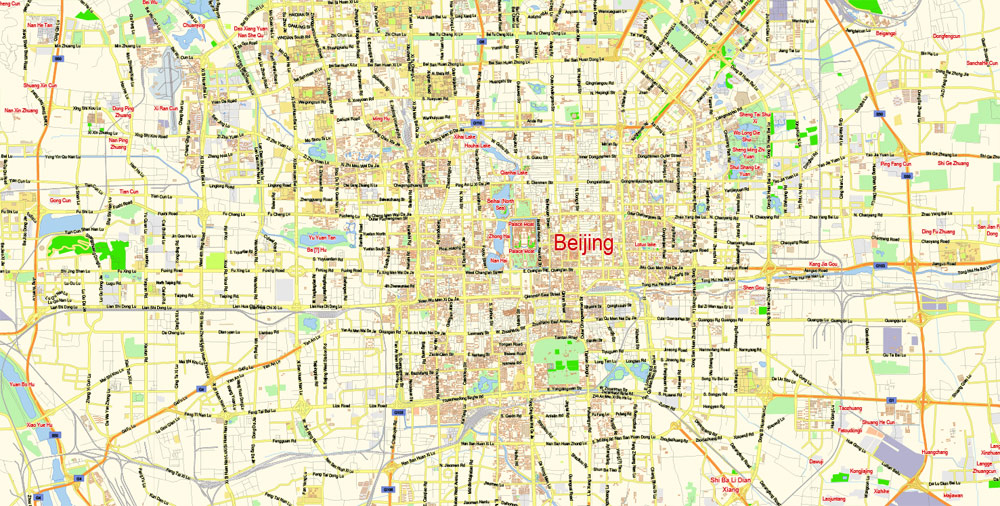
Related Images "Urban plan Beijing PDF":
China Beijing Digital Maps: For Business, Logistics, Education and Tourism
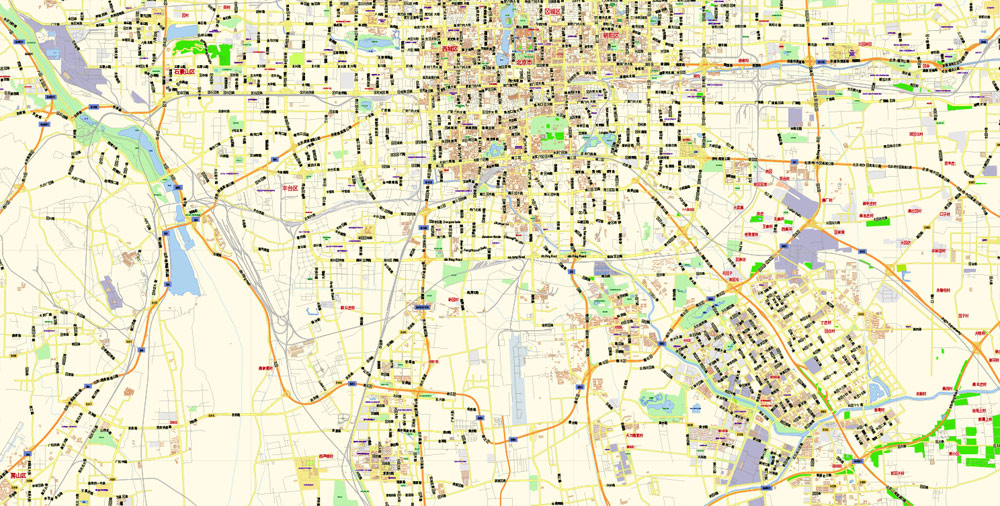
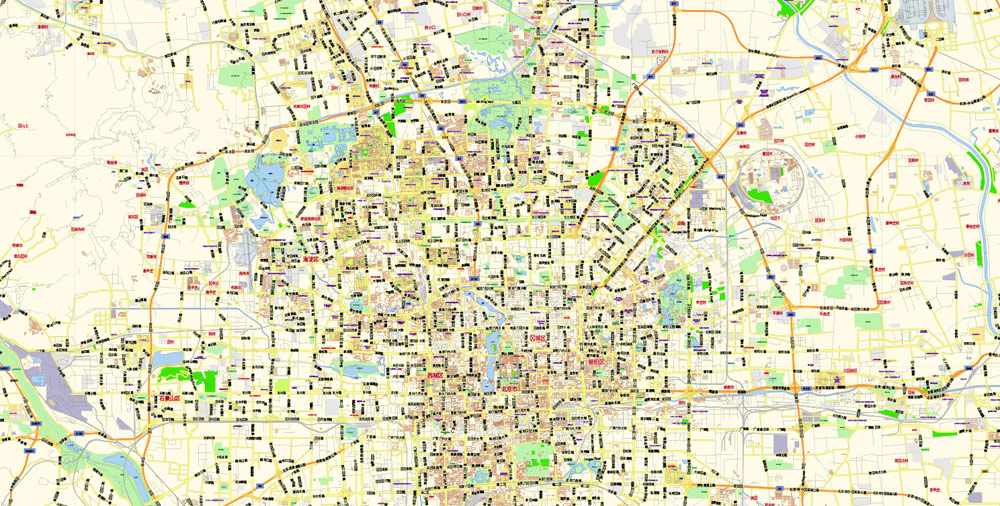
Planning in Restrictions for Beijing Urban and Rural: Digital Map Product
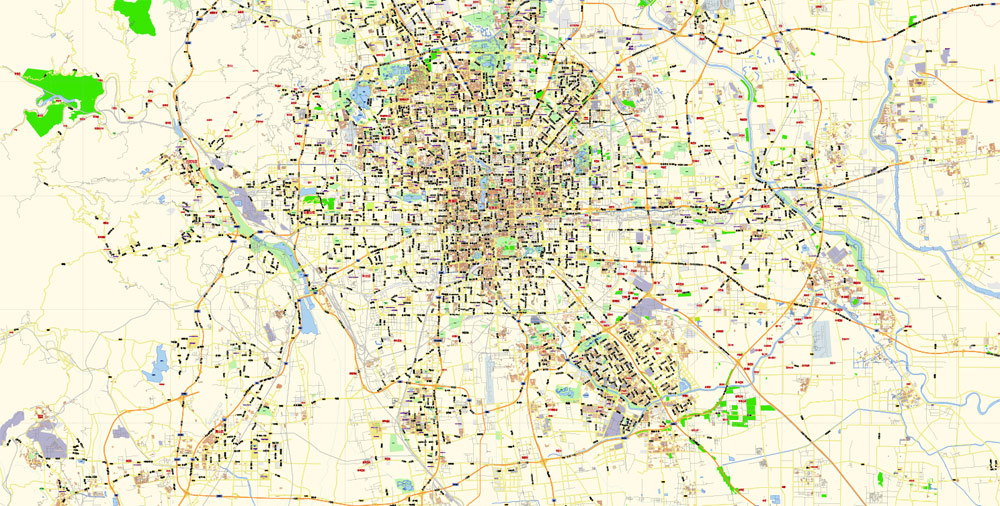
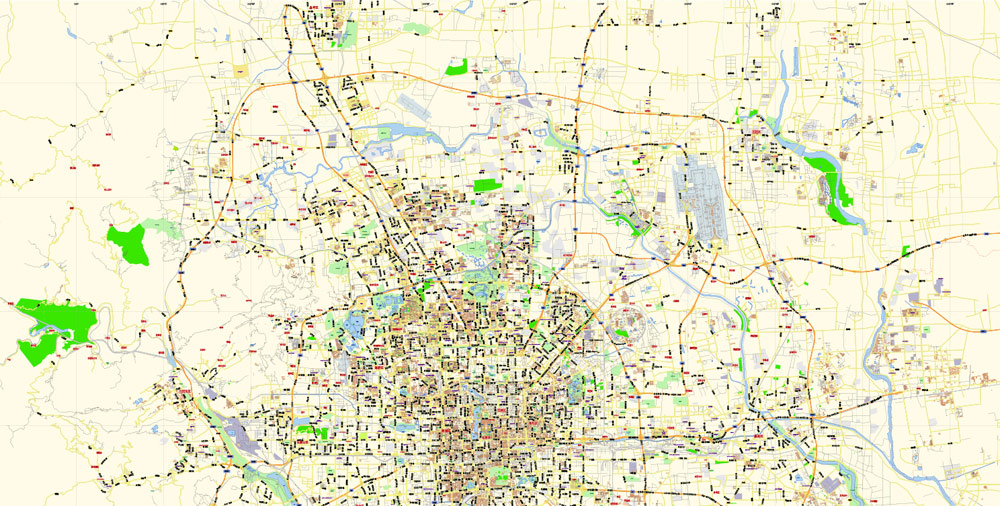
Beijing Vector Maps: Editable maps for printing
Beijings new urban master plan VECTOR CARTOGRAPHY
Geospatial Analysis Urban Planning in Beijing
- Urban plan Macon Georgia
- Urban plan Melbourne Australia PDF
- Urban plan Moscow S2
- Urban plan Des Moines Iowa
- Urban plan Tel Aviv Yafo Israel 12 PDF
- Urban plan Indianapolis
- Urban plan Newcastle UK
- Urban plan Espoo Finland pdf
- Urban plan Reno Nevada PDF
- Urban plan Hong Kong China 17 AI ENG
- Urban plan Portland Oregon Vancouver Washington 13
- Urban plan Yale University New Haven Connecticut PDF
- Urban plan Glasgow Scotland pdf
- Urban plan US Canada all roads pdf
- Urban plan Birmingham UK
- Urban plan Liverpool UK pdf
- Urban plan Vladimir pdf
- Urban plan Quebec City Canada pdf
- Urban plan Bruxelles Brussels Belgium CDR
- Urban plan Severna Park Annapolis Maryland
- Urban plan Cork Ireland
- Urban plan Canada Admin Districts
- Urban plan Hungary ai
- Urban plan Marseille France
- Urban plan Milwaukee Wisconsin
- Urban plan Poznan Poland pdf
- Urban plan Boston Massachusetts low
- Urban plan Little Rock Arkansas 3 10
- Urban plan Rio de Janeiro Brazil
- Urban plan Paris Grande
- Urban plan Long Beach
- Urban plan Oakland Berkeley Richmond Alameda San Leandro Albany California
- Urban plan Haifa Israel pdf
- Urban plan Mexico topo roads admin
- Urban plan Madison Wisconsin
- Urban plan Alphen Aan Den Rijn Netherlands
- Urban plan Portland Maine
- Urban plan Eugene Springfield Oregon
- Urban plan Helsinki Espoo Vantaa PDF
- Urban plan Evansville 75 Indiana
- Urban plan Caracas Venezuela PDF
- Urban plan Bend Oregon EPS
- Urban plan Shanghai China AI ENG LOW
- Urban plan Phoenix Arizona
- Urban plan Raleigh North Carolina PDF
- Urban plan Zacatecas Mexico
- Urban plan Providence Rhode Island PDF AI
- Urban plan Voronezh
- Urban plan Cyprus Island CDR
- Urban plan Kyoto Japan 13 ai
- Urban plan St Petersburg Florida pdf
- Urban plan Laval Quebec
- Urban plan Gothenburg Sweden Goteborg Sverige PDF
- Urban plan Washington DC
- Urban plan Harlingen Texas 3 10
- Urban plan Pakistan Full
- Urban plan Abu Dhabi United Arab Emirates
- Urban plan Dortmund Germany
- Urban plan Saint Petersburg Tampa Florida
- Urban plan Havana Cuba