Urban plan Montpellier France: Editable Maps
Video: "Urban plans Cities of France":
Gallery of Images "Urban plan Montpellier France":
Urban plan Montpellier France: For Business, Logistics, Education
Montpellier (Languedoc-Roussillon region)
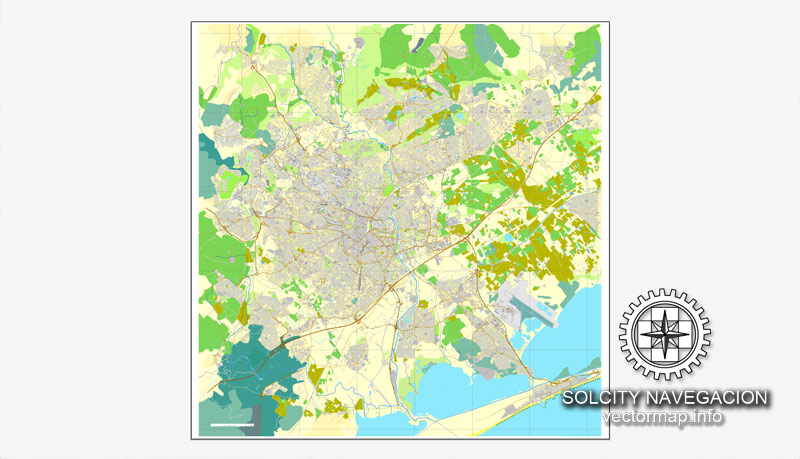
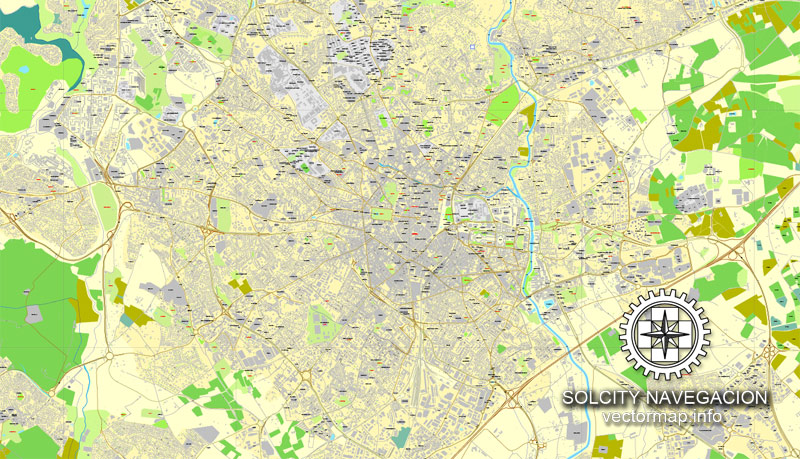
The French city of Montpellier is one of the largest settlements in the south of France, the eighth largest in the whole country, the administrative center of the Languedoc-Roussillon region, and the Herault department.
In fact, the city of Montpellier is located in the fertile and very picturesque valley of the Les River, which is 10 kilometers from the Mediterranean coast.
Centuries-old trade and intellectual activity have transformed Montpellier into a rich, energetic city. Benjamin of Tudela, a tireless Jewish traveler of the 12th century, said that his streets were filled with merchants from Egypt, Greece, Gaul, Spain, Genoa, and Pisa.
Several short-term drops in the "stock price" of the city, such as the sale of it to France in 1349, its almost complete destruction in 1622 for adherence to Protestantism, the decline of the wine trade at the beginning of the XIX century, in fact, could not slow down its development. Today, Montpellier, along with Toulouse, is considered the most dynamically developing city in the southern part of France.

In addition, its most famous university enjoys a particularly stable reputation – the University of Montpellier, founded in the XIII century, the authority of medical specialties of which is unshakable in our time. More than 60 thousand students set the intellectual and cultural tone of the city, whose average age is said to be only 25 years old.
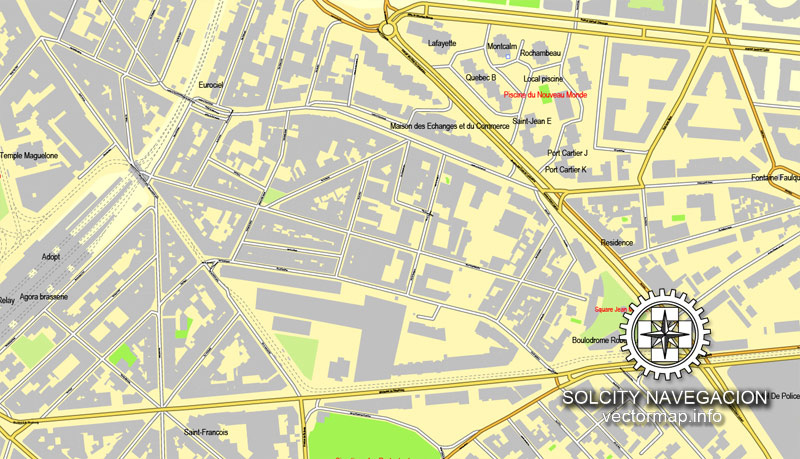
The railway and automobile stations are located next door at the far end of rue Maguelone if you look from the central square of the Comedy (de la Comedie). Montpellier-Mediterranean Airport (Montpellier-Mediterranee) is located 8 kilometers to the southeast, next to Lake Etang de Mauguio; buses depart every half hour from the bus station (15 minutes; 5 euros). Most of the city center is occupied by a pedestrian zone, so you should look for a parking place. The best areas are Antigone in the east and Boulevard des Arceaux in the west.
The city tourist office, where the currency exchange office operates, is located in the eastern part of the Place de la Comedie (place de la Comedie) opposite the Polygon shopping center. City buses THERE (Transport de l'agglomeration de Montpellier) – a public transport network - run between train stations and remote areas (to coastal Palavas).
Petibus mini-buses serve the city center - a ticket costs € 1.30 (a one-day ticket costs € 3.20) and is valid for both services for one hour, including transfers. Montpellier is also crossed from northwest to southeast by tram lines and entangled with more than 120 kilometers of bike paths reaching the sea.
Most of the city's hotels are conveniently located on the streets between the train station and Place de la Comedie (place de la Comedie) or in the nearby center of the Old Town. In addition to hotels, there is a well-equipped hostel in the city, located in a restored old house in a cul-de-sac (impasse) Petite Corraterie (rue des Ecoles Laiques; closed: mid-December - mid-January; bus number 6, stop "Ursulines"), as well as several campsites around Montpellier, especially in nearby Palavas (bus number 28; closed: mid-October - March).
1). Hotel Edouard VII is a pleasant place. A large old building of the XIX century. It offers suites with TV. Hotel address: 10 rue Aristide Ollivier;
2). Hotel Des Etuves - Simple, clean rooms in the Old Town, all have a bath, toilet and TV. Hotel address: 24 rue des Etuves;
3). Hotel Floride is a nice and clean place, popular among young travelers. All rooms have a TV. Hotel address: 1 rue Francois-Perrier;
4). Hotel Le Guihem is a beautifully restored mansion of the XVI century, with a sun-drenched veranda for breakfast. The windows of his friendly rooms overlook mainly the quiet garden. Hotel address: 18 rue J.-J.-Rousseau;
5). Hotel Le Mistral is a nice comfortable hotel with satellite TV and a parking garage (extra 5 euros). Hotel address: 25 rue Boussairolles;
6). The New Hotel du Midi is a very luxurious hotel, but at reasonable prices. Hotel address: 22 boulevard Victor-Hugo;
7). Hotel Du Palais is a tastefully restored 18th-century mansion in the western part of the Old Town. Hotel address: 3 rue du Palais;
8). The Royal Hotel is an aging but well-maintained three-star hotel located between Place de la Comedie and the railway station. Hotel address: 8 rue Maguelone.
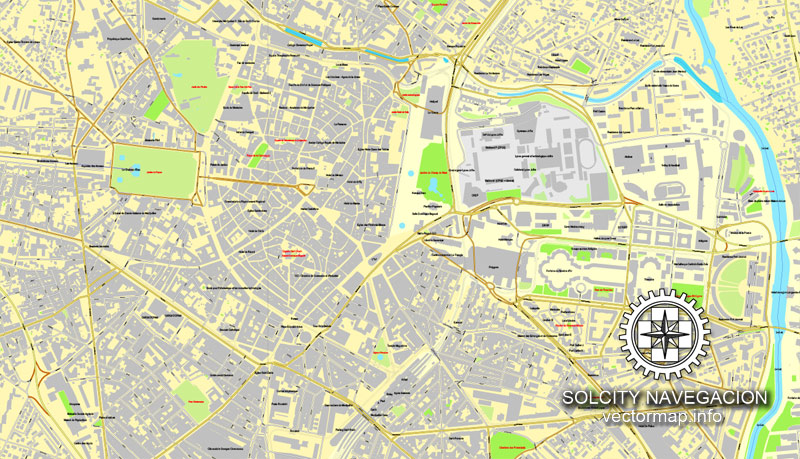
The central part of Montpellier is the Old Town - small, compact, architecturally homogeneous, full of charm and life, but not in July and August when students are on vacation and everyone spends time on the beach. In addition, the city is almost entirely a pedestrian zone, so you can stroll through the narrow streets without looking anxiously over your shoulder. The center of urban life connecting the old part with the new areas is the Place de la Comedie (place de la Comedie), or "L'Oeuf" ("Egg").
This huge oblong square is paved with cream-colored marble. In its center, there is a fountain, and on all sides, there are various cafes. At one end of the square stands the Opera, an ornate theater building built in the XIX century. The other end opens onto the Esplanade, an ideal place for relaxing walks, planted with rows of trees, at the end of which you will see the Corum Concert Hall.
Its building is built into the hillside, and the upper part is covered with pink granite; from its roof, there are wonderful views. In the Fabre Museum (Le Musee Fabre) you can see a large and historically valuable collection of paintings of the XVII-XIX centuries: French, Spanish, Italian, Dutch, Flemish, and English paintings, including works by Delacroix, Raphael, Jan van Sten, and Veronese.
Starting on the north side of L'Oeuf, rue de la Loge and rue Foch, radically rebuilt in the 1880s during the Montpellier reconstruction boom in the style of Baron Haussmann's designs, cut through the heart of the Old Town. From each of them departs a maze of narrow streets running up or down to modern boulevards.
Few buildings erected before the siege of 1622 have been preserved, but the industrious urban bourgeoisie quickly made up for the losses, showing its financial strength in many ascetic palaces of the XVII and XVIII centuries. The area known as "Lou Claps" (cobblestone) is being rapidly restored and gentrified. It is a pleasure to walk through it when you come across hidden small squares like the squares of Saint-Roch (place St-Roch), Saint-Ravi (place St-Ravy), and de la Canourgue (place de la Canourgue).
The first to the left of de la Loge (rue de la Loge) departs the Grand Rue Jean-Moulin (Grande-Rue Jean-Moulin), where Jean Moulin, the hero of the Resistance, lived in house No. 21. The modern Chamber of Commerce occupies house No. 32 on the left side of the street – one of the most elegant mansions of the XVIII century, Hotel St-Come, which was originally built as an operating room for a demonstration to medical students. On the opposite corner, the rue de l'argenterie rises to the Place Jean Jaures (place Jean-Jaures).
This square is the nodal point of the student life of the city: in fine weather between six and seven in the evening, you will have the impression that half of the population who is not on the Place de la Comedie is sitting here and on the adjacent Place du Marche-aux-Fleurs. Behind the Gothic portal of house No. 10 on the square of Jean Jaures is the so-called palace of the kings of Aragon, who owned Montpellier in the XIII century. Nearby is the Al Castellane (Halles Castellane), an attractive market building framed by iron structures.
Not far from Jean Jaures Square, in the Hotel de Varenne mansion on place Petrarque, you will find two museums of local history with a somewhat specialized profile: the Museum of Old Montpellier (Musee de Vieux Montpellier), which introduces the history of the city, and the more interesting private Museum of Fougau (Musee Fougau), whose expositions represent the history of Languedoc.
To the right of this building, on the lively little street Tresoriers de France (rue des Tresoriers-de-France), there is one of the best houses in the city built in the XVII century - the Lunaret mansion (house No. 5), and if you turn through the block to the Rue Jacques Coeur, you will find the Languedoc Museum (Musee Languedocien), in a very diverse collection, which houses exhibits from Greece, Egypt, and also other antiquities.
On the hill at the end of rue Foch, from which the Royal artillery bombarded Protestants in 1622, the English-style garden on the Promenade du Peyrou overlooks the city and the Pic Saint-Loup, towering over the area west of Montpellier, and the distant contours of the Cevennes beyond it.
At the far end of the city, a water tower decorated with ornaments of garlands and columns marks the end of the aqueduct, built in the XVIII century on the model of Pont du Gard. Below, under the two rows of arches of this aqueduct, there is a daytime fruit and vegetable market, and on Saturdays a huge flea market is open. At the end of the Promenade du Peyrou is the Arc de Triomphe, reminding the locals of the victory of Louis XIV over their Protestant "heresy".
Going down the hill to Boulevard Henri IV (boulevard Henri-IV), you will see a cute, but slightly neglected botanical garden (Jardin des Plantes). The garden was founded in 1593 and is the oldest in France. Across the street is the long-suffering Montpellier Cathedral or St. Peter's Cathedral (Cathedrale Saint-Pierre de Montpellier) with a massive porch, flaunting a motley mix of styles from the XIV to the XIX century. Inside it is a monument to the Bishop of Montpellier, who supported half a million local winegrowers who did not want to put up with their plight and went to a demonstration in 1907 (during which they were shot by government troops).
Above the cathedral, in the building of the prestigious University School of Medicine, there is the Musee Anger (rue de l'Ecole-de-Medicine), which has an outstanding academic collection of French and Italian drawings, while the creepy Museum of Anatomy (Musee d'Anatomie) exhibits various horrors in vessels. Nearby is the pretty little place de la Canourgue and further down the rue d'Aigrefeuille - the old university quarter with several good bookstores on the University Street (rue de l'Universitye).
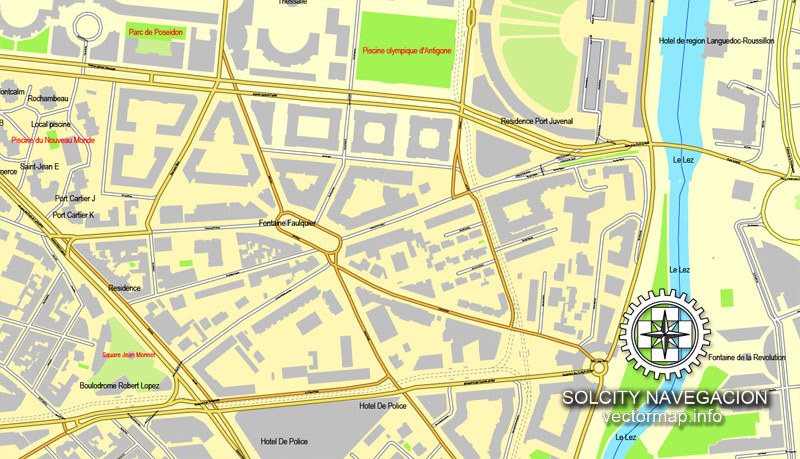
To the south of Place de la Comedie lies the controversial Antigone district – a chain of postmodern quarters and open spaces stretched along a grand axis from Place du Nombre-d'Or through Place du Millenaire to the glazed arch of the Mansion de la Région (Hotel de la Region). This project is much more interesting in scale and essence than most attempts to renovate the city, but it has failed in an attempt to distract the masses of people from the Place de la Comedia and often looks deserted.
The French city of Montpellier (Languedoc-Roussillon region) it is active all year round, so there are a large number of restaurants and bars for every taste and budget. Cafes fringe any%